
When you're staring down the options of a 401(k), a Traditional IRA, or a Roth IRA, it really all comes down to one big question: Do you want a tax break today, or do you want tax-free income when you retire?
Your answer will likely change depending on your current income, what your employer is offering, and where you think you'll be financially years from now. A 401(k) and a Traditional IRA give you that immediate gratification—a tax deduction on your contributions right now. A Roth IRA, on the other hand, plays the long game, giving you completely tax-free withdrawals down the road.
Choosing Your Path to Retirement Savings
Picking the right retirement account can feel overwhelming, but each one is built to serve a different purpose. Getting a handle on how they work is the first real step to building a solid savings strategy. Here at Spivak Financial Group, we spend our days helping clients—especially those planning for early retirement—cut through the noise and make the right call for their specific situation.
The 401(k) is the one you get through work. Its biggest selling point is often the company match, which is basically free money you should never leave on the table. An Individual Retirement Arrangement (IRA) is an account you set up yourself, which gives you far more control and a much wider universe of investment options.
From there, the main fork in the road is how they’re taxed:
- Tax-Deferred (Traditional 401(k), Traditional IRA): You put money in before taxes are taken out, which lowers your taxable income for the year. Your money grows without being taxed along the way, but you'll pay regular income tax on every dollar you withdraw in retirement.
- Tax-Free (Roth IRA, Roth 401(k)): You contribute money you've already paid taxes on, so there's no upfront tax break. The magic happens later: your investments grow completely tax-free, and when you take qualified withdrawals in retirement, you won't owe a dime in taxes.
At a Glance: 401(k) vs. Traditional IRA vs. Roth IRA
To make things a bit clearer, here’s a quick side-by-side look at the key features. This table gives you the high-level summary before we get into the nitty-gritty details.
| Feature | 401(k) | Traditional IRA | Roth IRA |
|---|---|---|---|
| Account Type | Employer-Sponsored | Individual | Individual |
| Contribution Tax Treatment | Pre-tax (lowers current income) | Pre-tax (deduction may be limited by income) | Post-tax (no immediate deduction) |
| Withdrawal Tax Treatment | Taxed as ordinary income | Taxed as ordinary income | Tax-free (qualified distributions) |
| Key Benefit | Potential employer match | Wide investment choice, tax deduction | Tax-free growth and withdrawals |
| Income Limits | No limit on contributions | Deduction limits for high earners | Contribution limits for high earners |
Think of this table as your starting point. Each of these features has nuances that can make a huge difference depending on your goals.
Recent trends show a definite shift in how people are saving. The average 401(k) savings rate just hit a record 14.3% of income. Even more telling is that 94.4% of plans now offer a Roth 401(k) option, according to recent findings on current retirement savings trends from ASPPA. This tells us that more and more people are prioritizing tax-free income in retirement—a strategy that's particularly powerful for anyone figuring out how to retire at 50.
Decoding Contribution Rules and Income Limits
Getting a handle on how much you can contribute—and if you can contribute at all—is a huge part of the 401(k) vs. IRA debate. These rules aren’t just fine print; they can completely dictate your savings strategy, especially as your income climbs. The IRS adjusts these limits every year to keep things fair.
Each account has its own lane when it comes to contribution ceilings. Employer plans like the 401(k) have much higher limits because they're designed to be the primary savings vehicle for most working Americans. IRAs, on the other hand, have lower limits but give you more personal control over your investments.
Contribution Ceilings and Catch-Up Provisions
For 2025, you can sock away up to $23,500 in your 401(k). That high ceiling is a game-changer if you're trying to save aggressively and build a serious nest egg. Plus, the rules throw a bone to those of us getting closer to retirement.
If you're 50 or older, you can make extra "catch-up" contributions. This lets you add another $7,500 to your 401(k), pushing your total potential contribution to a whopping $31,000 for the year. This is an incredible feature for anyone who got a late start on saving or just wants to pour it on in their final working years.
Over in the world of IRAs (both Traditional and Roth), the limits are a bit more modest. For 2025, you can contribute up to $7,000. The catch-up for those 50 and over is also smaller, at an extra $1,000, for a total of $8,000 per year.
The massive difference in contribution limits is a major fork in the road. A high-earner looking to max out their savings will lean heavily on their 401(k). An IRA is more of a powerful supplement to that strategy.
The Impact of Income on Eligibility
This is where the accounts really start to show their differences. With a 401(k), your income doesn't matter. You can earn $50,000 or $500,000 and still contribute the maximum amount allowed. This makes the 401(k)—including its Roth version—a go-to for high-income professionals.
IRAs, however, play by a different set of rules that can limit you based on how much you make.
- Roth IRA: Your ability to contribute directly gets phased out based on your Modified Adjusted Gross Income (MAGI). For 2025, if you're a single filer earning more than $165,000, you're locked out completely.
- Traditional IRA: Anyone with earned income can contribute, but your power to deduct those contributions on your taxes disappears if you're also covered by a workplace plan like a 401(k).
The contrast is especially stark when you look at the Roth options. You can put up to $23,500 into a Roth 401(k) (or $31,000 if you're 50 or older) regardless of your salary. But as this comparison from Schwab details, the Roth IRA has much lower contribution caps and those strict income limits. That makes the Roth 401(k) an incredibly valuable high-limit savings tool for earners at every level.
Comparing Tax Treatments Now and in Retirement
When you get down to it, the whole 401(k) vs. IRA vs. Roth debate boils down to one simple, yet profound, question: Would you rather pay taxes now or later? Your answer is everything. It shapes your entire financial strategy and determines which account is truly the right fit for your wealth-building journey.
Traditional 401(k)s and Traditional IRAs run on a "pre-tax" or "tax-deferred" model. What this means is that your contributions can lower your taxable income right now, giving you some immediate relief. For instance, if you put $5,000 into a Traditional IRA, your taxable income for the year drops by that same $5,000, potentially saving you a nice chunk of change today.
This strategy is especially powerful when you're in your peak earning years. By pushing taxes down the road, you shrink your current tax bill while your investments grow without being nicked by annual taxes on dividends or capital gains. The catch? The tax man eventually comes calling. Every dollar you pull out in retirement is taxed as ordinary income.
The Power of Post-Tax Contributions
On the flip side, you have the Roth IRA, which is funded with "post-tax" contributions. You’re putting money in after you've already paid income tax on it, so there's no upfront tax break. The real magic happens years later.
Because you settled your tax bill on the way in, all of your investment earnings grow completely tax-free. Even better, every qualified withdrawal you take in retirement is 100% tax-free. This gives you an incredible amount of certainty—you know exactly how much money you have to spend, without guessing what future tax rates might do to your savings.
The core decision really hinges on your marginal tax rate now versus what you expect your effective tax rate to be in retirement. If you think you'll be in a higher tax bracket later, paying taxes now with a Roth makes a ton of sense. If you anticipate a lower tax bracket when you retire, deferring taxes with a Traditional account is usually the smarter move.
Choosing Your Tax Strategy
Deciding between paying taxes now or later isn't a random guess; it's a strategic calculation based on where you are in your career and where you're headed.
- Choose Pre-Tax (Traditional 401(k)/IRA) If: You're in your highest-earning years and sitting in a high tax bracket. That immediate tax deduction is incredibly valuable, and you expect to be in a lower tax bracket when you start taking withdrawals in retirement.
- Choose Post-Tax (Roth IRA) If: You're early in your career and expect your income—and your tax bracket—to climb significantly. Paying taxes now at a lower rate means you avoid paying much higher taxes on a much larger nest egg down the road.
This "Roth or not to Roth" dilemma is a cornerstone of smart retirement planning. For a deeper dive, our guide on when a Roth makes sense can give you more clarity on this critical choice. Ultimately, picking the right tax treatment is about aligning your contributions with your long-term financial forecast.
Navigating Investment options and The Employer Match

When you look past the tax rules, the practical differences between a 401(k) and an IRA really start to shape your wealth-building journey. Both are fantastic tools, no doubt. But their contrasts in investment choices and unique perks—like an employer match—give each a distinct edge. Getting these details right is how you truly optimize your strategy.
The single most powerful feature of a 401(k) is the employer match. Seriously, think of it as a guaranteed, immediate return on your investment that you just can't get anywhere else. If your company offers a dollar-for-dollar match on up to 5% of your salary, contributing that 5% means you instantly double your money.
Skipping the match is like saying "no thanks" to a 100% return before your money even has a chance to see market growth. There isn't another investment out there that can promise that kind of instant boost. It should be the absolute first step in any retirement plan.
The Trade-Off: Simplicity vs. Freedom
Once you've captured your full employer match, the game changes. The spotlight shifts to investment flexibility, and this is where IRAs—both Traditional and Roth—really pull ahead.
Most 401(k)s give you a limited menu of investment options. You'll typically see a handful of mutual funds and target-date funds that were chosen by your employer's plan administrator. It's simple, but it's restrictive.
An IRA, on the other hand, swings the doors wide open to a massive investment universe. You can pick and choose individual stocks, bonds, exchange-traded funds (ETFs), real estate investment trusts (REITs), and much more. This is the kind of control that lets you build a portfolio perfectly tailored to your goals and risk tolerance.
The core trade-off is straightforward: A 401(k) offers simplicity and the unbeatable employer match, while an IRA provides unparalleled investment freedom. The ideal strategy for many is to contribute enough to the 401(k) to get the full match, then direct additional savings into an IRA.
Balancing Control, Costs, and Growth
Of course, fees and account management also play a huge role. Employer-sponsored 401(k) plans often have administrative fees that can quietly eat away at your returns over the long haul. While costs have decreased over the years, they’re still something you have to watch.
With IRAs, you can often open an account with a brokerage firm that charges zero administrative fees. You’ll still pay the expense ratios on the funds you select, but you have more control over keeping those costs low.
This control extends to how your money is managed. With an IRA, you're the one calling the shots. That autonomy is perfect for hands-on investors, but might feel like a burden to someone who prefers a "set-it-and-forget-it" plan. The right account for you will always be a careful balance of growth potential, costs, and the level of involvement you're comfortable with.
Recent data shows just how powerful these accounts can be when used together. As of mid-2023, the average IRA balance was about $131,400, while the average 401(k) balance was $127,100. Baby Boomers are especially kicking their savings into high gear, with average quarterly contributions jumping 21% year-over-year. You can dig into these IRA and 401(k) balance trends from Kiplinger to see how people are leveraging both accounts to build a solid nest egg.
Understanding Withdrawal Rules and Early Access
Getting your hands on your retirement money is governed by a pretty strict set of rules. When you're comparing a 401(k) vs. an IRA vs. a Roth IRA, these access rules are a huge deal. The IRS really wants that money to stay put for your actual retirement, and they enforce this with a hefty 10% early distribution penalty if you take funds out before age 59½.
This penalty isn't a slap on the wrist. It gets stacked right on top of the ordinary income taxes you'll owe on the withdrawal, which can be a painful double-hit to your savings. For pre-tax accounts like a Traditional 401(k) or a Traditional IRA, that means paying both income tax and the penalty. With a Roth IRA, the penalty only applies to withdrawn earnings, not your original contributions.
But life doesn't always stick to the plan, so the IRS created several key exceptions. These waivers let you tap into your savings for specific reasons without getting hit by that 10% penalty, though you’ll likely still owe income tax on the withdrawal.
Navigating Early Withdrawal Penalty Exceptions
While the 59½ rule is the standard, each account offers slightly different escape hatches for penalty-free early access. It's critical to know that even if the IRS waives the penalty, your 401(k) plan doesn't have to allow the distribution in the first place. This is one area where IRAs usually offer a lot more freedom.
Some of the most common penalty exceptions you'll find across all three accounts include:
- Total and Permanent Disability: If you become permanently disabled, you can access your retirement funds without the 10% penalty.
- Death of the Account Owner: Your beneficiaries can withdraw the funds without facing an early withdrawal penalty.
- Substantially Equal Periodic Payments (SEPP): This is an incredibly powerful tool for early retirement, often called a 72(t) distribution.
The Roth IRA really shines when it comes to flexibility. Since you funded it with after-tax dollars, you can withdraw your own contributions—not the earnings—anytime, for any reason, completely tax-free and penalty-free. This makes it a fantastic hybrid account that can double as a retirement nest egg and a robust emergency fund.
The Power of the 72(t) SEPP for Early Retirement
For anyone serious about retiring well before age 59½, the Substantially Equal Periodic Payment (SEPP), or 72(t) plan, is an absolute game-changer. This IRS rule allows you to set up a series of scheduled annual withdrawals from your 401(k) or IRA, and as long as you follow the rules, you can bypass the 10% penalty entirely, no matter your age.
This strategy isn't something you jump into lightly; it demands careful, precise planning. You have to commit to taking these payments for at least five years or until you turn 59½, whichever is longer. The amount you can take is calculated using one of three specific IRS-approved methods based on your account balance and life expectancy. One misstep can trigger retroactive penalties on every single distribution you've taken, so getting professional guidance is non-negotiable.
Here at Spivak Financial Group, structuring 72(t) SEPP plans is what we do. For many early retirees, these plans are the financial bedrock that provides a steady income stream, bridging the gap until they reach traditional retirement age. To get a feel for whether this approach could work for you, check out our in-depth guides at 72tProfessor.com. It’s a complex path, but for those determined to unlock their retirement savings early and on their own terms, it's an incredibly rewarding one.
Making the Right Choice for Your Financial Journey
Poring over the details of 401(k)s, Traditional IRAs, and Roth IRAs is one thing, but translating that into a real-world plan is where it counts. The truth is, there's no single "winner" in this debate. It's about picking the right tool for the right job at a specific point in your life. Your age, your income, and where you see your career going are the real drivers behind this decision.
Let's walk through a few common scenarios to see how this plays out in practice.
Actionable Strategies for Different Life Stages
Your financial priorities aren't static; they shift as you build your career and your life. Your retirement strategy needs to be just as flexible. What makes sense for someone just starting out is completely different from what a seasoned executive should be doing.
-
For the Young Professional: If you're in the early stages of your career, chances are your best earning years are still ahead of you. This is the absolute sweet spot for a Roth IRA. By paying taxes on your contributions now, while you're likely in a lower tax bracket, you're buying yourself a future of completely tax-free growth and withdrawals. But first things first: always, always contribute enough to your 401(k) to get the full employer match. It’s an unbeatable return you can't get anywhere else.
-
For the High-Earning Executive: When you're at the peak of your career, your marginal tax rate can be painfully high. This is where a Traditional 401(k) really pulls its weight. Maxing out your pre-tax contributions gives you a significant, immediate tax deduction that lowers your current tax bill. The entire game here is to defer paying taxes until retirement, when your income—and therefore your tax bracket—will likely be much lower.
-
For the Self-Employed Individual: Working for yourself opens up some incredibly powerful options, like a SEP IRA or a Solo 401(k). These accounts let you contribute far more than a standard IRA because you can contribute as both the "employee" and the "employer." The decision between pre-tax and Roth contributions follows the same core logic: lean toward Roth if you expect your income to grow, and stick with Traditional if you're in your prime earning years now.
The chart below gives you a simple visual for thinking about withdrawal rules, centering on that critical age 59½ milestone.
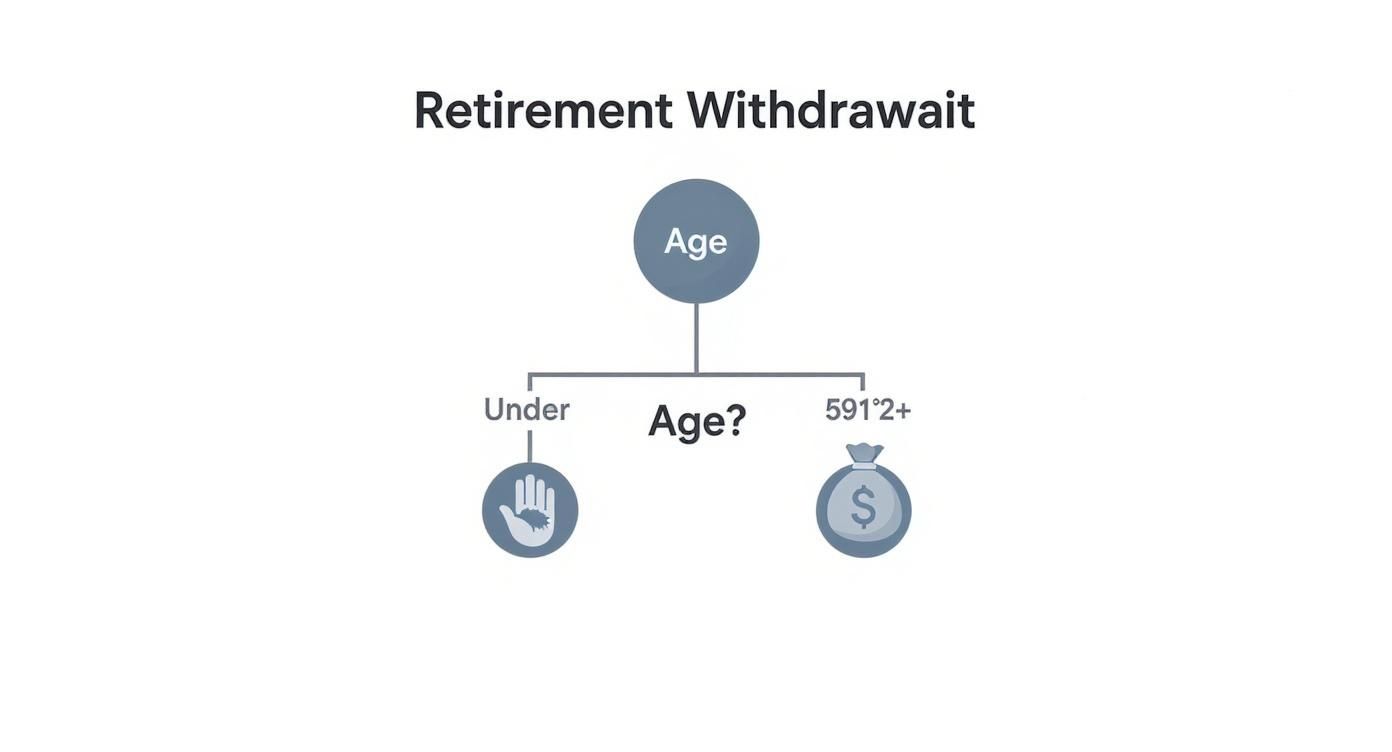
This flowchart illustrates the basic rule of thumb for penalty-free access, which is the foundation of most traditional retirement planning.
Combining Accounts for a Powerful Hybrid Strategy
For most people, the best approach isn't choosing one account over another but creating a powerful combination that works together. One of the most effective strategies is beautifully simple: contribute to your 401(k) just enough to secure the full employer match. Once you've done that, shift your focus to a Roth IRA and contribute as much as you can, up to the annual limit. If you still have money to save after maxing out both of those, circle back and put more into your 401(k).
This hybrid approach ensures you never leave free money on the table (the match) while simultaneously building a bucket of tax-free money for retirement. That tax diversification is absolutely critical down the road.
When your financial situation gets more complex—especially if early retirement is on your radar—generic advice simply won't cut it. Navigating sophisticated strategies like a 72(t) SEPP or juggling multiple income streams requires specialized expertise. At Spivak Financial Group, we help clients build these kinds of nuanced plans to meet their unique financial goals.
Frequently Asked Questions About Retirement Accounts
When you're trying to choose between a 401(k), a Traditional IRA, or a Roth IRA, it's completely normal to have some questions pop up. Getting those questions answered is the first step toward building a retirement strategy you can feel confident about. Let's walk through some of the most common ones we hear from our clients.
Can I Have a 401k and an IRA at the Same Time?
Yes, absolutely. In fact, if you have the means, contributing to both is a fantastic strategy. It’s very common to contribute to your workplace 401(k) while also funding a separate IRA on your own.
This one-two punch lets you grab any employer match offered in your 401(k)—that's free money—while using an IRA for extra tax-advantaged savings and much broader investment options. Just be aware that if you have a workplace plan, the tax deductibility of your Traditional IRA contributions might be limited depending on your income. Roth IRA contributions are also subject to their own income limits.
What Happens to My 401k if I Leave My Job?
Your 401(k) doesn't vanish when you change jobs. You have a few choices, and it's important to pick the right one for your situation. Here are the four main paths you can take:
- Leave it behind: If your account balance is over a certain threshold (usually $5,000), you can often just leave the money in your old employer's plan.
- Move it to your new job's plan: Your new employer might let you roll the funds from your old 401(k) into their plan.
- Roll it over into an IRA: This is an extremely popular option because it puts you in the driver's seat, giving you total control over your investments and often access to lower fees.
- Cash it out: This is almost always a bad idea. Not only will you owe income taxes on the full amount, but you'll also get hit with a painful 10% early withdrawal penalty if you're under 59½.
Rolling your old 401(k) into an IRA is often the most strategic move. It consolidates your money in one place and opens up a universe of investment choices that most 401(k) plans simply can't match.
Which Is Better if My Taxes Will Be Higher in Retirement?
This is a great question, and the answer is pretty clear-cut. If you expect to be in a higher tax bracket when you retire, a Roth account is almost always the way to go. That includes both the Roth IRA and the Roth 401(k).
The logic is simple: you pay taxes on your contributions now, at what you assume is a lower tax rate. In exchange, all your qualified withdrawals in retirement are completely tax-free. You're essentially locking in today's tax rates on that money, shielding your nest egg from the uncertainty of what tax rates might look like down the road. It's a powerful way to build tax diversification into your retirement income plan.
At Spivak Financial Group, we specialize in crafting retirement strategies that align with your unique goals, especially for those aiming to retire early. A 72(t) SEPP can provide the penalty-free income you need to make your dreams a reality. To learn more about how to unlock your retirement funds ahead of schedule, visit us at 72tProfessor.com, call us at (844) 776-3728, or stop by our Scottsdale office.