
For anyone with a 401(k), the number 59 ½ is more than just an age—it's a critical milestone. This is the age the IRS has designated as the point when you can finally access your retirement funds without getting hit with the dreaded 10% early withdrawal penalty. Think of it as the 'golden key' to unlocking decades of your hard-earned savings.
Just be careful not to mistake "penalty-free" for "tax-free." That's a crucial distinction we'll get into.
Unlocking Your 401(k) at Age 59 1/2
For years, your 401(k) has likely felt like a secure vault with some pretty strict rules on getting your money out early. The age 59 ½ rule is what finally swings open the doors to that vault without the usual alarm bells—in this case, the 10% penalty designed to keep people from dipping into their retirement funds prematurely.
Before hitting this magic number, pulling money out usually comes with a steep price: you pay your ordinary income tax plus that extra penalty. Once you cross the 59 ½ threshold, that penalty officially vanishes, giving you a whole new level of financial flexibility. This isn't just a 401(k) thing; the rule generally applies across most retirement plans, including 403(b)s and traditional IRAs.

The Core Principle of the Rule
So, why 59 ½? The government’s goal is simple: to make sure your retirement savings are actually there for, well, your retirement. By slapping a penalty on early withdrawals, they create a strong incentive for us to let that money grow long-term instead of using it for short-term expenses.
When you reach 59 ½, the IRS essentially considers you at or very near retirement age, so the penalty is no longer necessary. This marks a huge shift in your financial life, moving from a phase of accumulating wealth to a phase of distributing it. Getting a handle on this transition is absolutely key to building a solid retirement income plan.
One of the biggest misconceptions out there is that hitting 59 ½ makes all 401(k) withdrawals completely free and clear. While the 10% penalty does go away, you still have to pay ordinary income tax on every dollar you take out from a traditional, pre-tax 401(k).
How Your Withdrawal Status Changes
The difference in how your withdrawal is treated before and after this birthday is night and day. It has a direct and significant impact on how much money actually ends up in your pocket.
To put it in perspective, taking a $20,000 withdrawal at age 58 could cost you an extra $2,000 in penalties. Waiting just a couple of years until after you turn 59 ½ saves you that $2,000 instantly.
Here’s a quick summary of how things change.
Withdrawal Status Before vs After Age 59 1/2
This table breaks down the key differences in how the IRS treats a standard 401(k) withdrawal based on your age.
| Withdrawal Scenario | Before Age 59 1/2 | After Age 59 1/2 |
|---|---|---|
| 10% Early Withdrawal Penalty | Yes, this penalty typically applies to the amount withdrawn. | No, the penalty is waived. |
| Federal Income Tax | Yes, withdrawals from pre-tax accounts are taxed as ordinary income. | Yes, this still applies to pre-tax funds. |
| Access to Funds | Restricted to specific events (like a hardship) or you pay the penalty. | Unrestricted penalty-free access is allowed. |
Understanding these fundamental mechanics is the first step toward making smarter decisions with your retirement funds. By grasping the core of the 59 ½ withdrawal 401(k) rule, you can better plan your transition into retirement. Of course, this is just the beginning—the tax implications are the next critical piece of the puzzle.
How Taxes Impact Your 401k Distributions
Hitting age 59½ is a major milestone. You’ve finally unlocked your 401(k) without the threat of that dreaded 10% early withdrawal penalty. But before you celebrate, it's crucial to understand that you haven't received a free pass from taxes.
For years, your traditional 401(k) has been growing in a tax-deferred shelter. This means you haven't paid a dime in taxes on your pre-tax contributions or all the investment gains. Now that you're ready to start taking money out, Uncle Sam is ready to collect.
Every single dollar you pull from a traditional 401(k) after this age is treated as ordinary income. This is a critical point that trips many people up. It's not taxed at the lower long-term capital gains rates you see on other investments. Instead, it gets added right on top of your other income for the year—like any final paychecks or Social Security benefits—and taxed at your regular marginal tax rate.
Understanding How Withdrawals Affect Your Tax Bracket
Taking a sizable distribution can have a surprisingly big impact on your annual tax bill. Because that withdrawal amount gets tacked onto your total income, it can easily bump you into a higher tax bracket, which means a bigger chunk of your money goes to the IRS.
Let's walk through a real-world scenario. Imagine you have an annual income of $60,000 and decide to take a $50,000 lump-sum distribution from your 401(k) to pay for a kitchen remodel. For tax purposes, your income for that year just jumped to $110,000. That leap could easily push you into a new tax bracket and significantly increase what you owe.
Be prepared for this: The IRS requires your plan administrator to automatically withhold a flat 20% of your distribution for federal taxes if you take a lump-sum payment. On a $50,000 withdrawal, you’ll only get a check for $40,000. And even then, that $10,000 withholding might not be enough to cover your final tax liability.
That mandatory withholding is just a down payment on your taxes. Your actual bill could be higher or lower depending on your total income, deductions, and filing status. This is why careful planning is so important—no one wants an unexpected tax surprise.
Proactive Strategies to Manage Your Tax Burden
The key to a smart 59 1 2 withdrawal 401k strategy is all about managing the tax hit. Instead of yanking out one large sum, it's often better to take a more tactical approach.
- Time Your Withdrawals: Think about taking distributions in years when your overall income is lower. For example, if you plan to retire in June, waiting until the next calendar year to take a withdrawal means you'll have less employment income, potentially keeping you in a lower tax bracket.
- Take Smaller, Periodic Payments: Spreading your withdrawals over several years is a great way to stay below higher tax bracket thresholds. This approach gives you a steadier, more predictable income stream and makes your tax bill much more manageable.
- Consider State Taxes: Federal taxes are just one piece of the puzzle. Most states also tax 401(k) distributions as income, so be sure to factor that into your planning.
Recent data from the Center for Retirement Research at Boston College shows that while 401(k) balances are growing, many people still tap into them early. Any withdrawal before 59½ undermines your retirement savings, thanks to that 10% penalty. Understanding these tax rules is the best way to preserve the nest egg you've worked so hard to build.
The Roth 401k A Tax-Free Alternative
On the flip side, the Roth 401(k) offers a powerful advantage. Since you made your contributions with after-tax dollars, your qualified withdrawals in retirement are completely tax-free.
To be considered a "qualified distribution" from a Roth 401(k), you have to meet two simple conditions:
- You must be at least 59½ years old.
- The account must have been open for at least five years (the "five-year rule").
As long as you meet both requirements, you can withdraw every penny of your contributions and all the earnings 100% tax-free. This makes the Roth 401(k) an incredible tool for generating a tax-free income stream in retirement. For those exploring other early withdrawal strategies, you can learn more about how 72(t) distributions are taxed in our detailed guide.
Navigating In-Service Withdrawals and Your Company's Rules
Hitting your 59½ birthday is a big deal in the eyes of the IRS. It’s the magic number that makes the dreaded 10% early withdrawal penalty vanish. But hold on—the IRS isn't the only one with a say in the matter. Your employer calls the shots, too.
While the IRS sets the nationwide standard, your company's 401(k) plan document lays out what you can actually do with your money while you’re still on the payroll. This brings up a critical term you need to know: the in-service withdrawal. It's exactly what it sounds like—taking money out of your 401(k) while you're still an active employee at the company.
Just because the IRS gives you the green light for a penalty-free 59 1/2 withdrawal 401k doesn't mean your plan has to open the gates. Your employer's plan has the final say, and they are definitely not all created equal.
Why Your Company's Plan Rules Matter Most
Think of it this way: The IRS rule is like a general admission ticket to a festival. But your company's 401(k) plan is the specific stage you want to see, and it has its own bouncer at the entrance. If the bouncer says "not on the list," your general admission ticket won't get you in.
Many 401(k) plans simply do not allow in-service withdrawals at all, even after you've hit 59½. Their main job is to safeguard your money for your actual retirement, and one way they do that is by locking it down until you leave the company—whether you resign, are terminated, or officially retire.
Other plans might give you a bit more flexibility, but with strings attached. They might let you touch certain pots of money but keep others off-limits. This is a huge point of confusion for people who understandably assume their entire balance is fair game.
Here’s the bottom line: Your 401(k) is governed by a detailed legal document that dictates every single rule. Never, ever assume you can access your funds without checking your specific plan rules first.
For instance, a plan might allow you to pull money from specific sources.
- Rollover Contributions: Funds you rolled in from an old 401(k) or an IRA are often the easiest to access.
- Vested Employer Contributions: You might be able to withdraw the company match or profit-sharing funds that are fully vested.
- After-Tax Contributions: If your plan allows non-Roth after-tax contributions, this money can usually be withdrawn.
But here’s the most common roadblock: many plans restrict access to your own pre-tax elective deferrals. That’s the money you put in from each paycheck, and it’s often locked up tight until you leave the company.
Finding the Rules in Your Summary Plan Description
So, where do you find these all-important rules? You're looking for a document called the Summary Plan Description (SPD). Your employer is legally required to give you one when you first enroll, and you can always ask HR or the plan administrator for an up-to-date copy.
The SPD is your official playbook. It will clearly state whether in-service withdrawals are allowed and, if so, under what specific conditions (like reaching age 59½) and from which sources of money. Reading this document is the single most important step you can take to avoid a nasty surprise.
A Tale of Two Colleagues
To see just how different these rules can be, let’s look at a real-world scenario.
Meet Sarah and Tom. They’re both 60 years old, have worked at their companies for two decades, and have built up solid 401(k)s. They both want to take out $30,000 for a home renovation.
- Sarah's Company: Her 401(k) plan is flexible. It allows in-service withdrawals of all vested funds once an employee turns 59½. She calls her plan administrator, fills out the paperwork, and gets her money (minus the required 20% tax withholding) without a hitch.
- Tom's Company: His employer’s plan is much stricter. It prohibits all in-service withdrawals until an employee leaves the company. When Tom calls HR, he’s told that even though he's over 59½, he can't touch his 401(k) as long as he’s still working there. His only potential option would be a 401(k) loan, assuming the plan even offers one.
This simple story highlights how two people in almost the exact same boat can face completely different realities. It all comes down to the fine print in their company's plan. Before you start planning what to do with a 59 1/2 withdrawal 401k, your first move should always be to confirm what your plan actually allows.
Exceptions That Waive the 10 Percent Early Withdrawal Penalty
While hitting age 59 ½ is the magic number most people know for penalty-free 401(k) access, it's not the only way. Life happens, and the IRS gets that. They’ve built in several important exceptions that let you tap your 401(k) before 59½ without that nasty 10% early withdrawal penalty.
These exceptions are usually tied to specific, often difficult, life events. Knowing what they are can provide a critical financial lifeline when you need it most. Just remember, even if the penalty is waived, you’ll almost always still owe ordinary income tax on the money you take out.
The Rule of 55
One of the most powerful exceptions for early retirees is the Rule of 55. The concept is simple, but the details are crucial: you must leave your job (whether you quit, get laid off, or retire) during or after the calendar year you turn 55.
If you meet that requirement, you can take penalty-free withdrawals from the 401(k) tied to that specific job. This is a key point—the rule only applies to the 401(k) from the employer you just separated from. Any money in old 401(k)s or IRAs is still locked up until you’re 59½.
For example, if you're laid off at age 56, you can start taking distributions from that company's 401(k) right away, penalty-free. This can be a total game-changer for bridging the income gap until your other retirement funds become available.
Total and Permanent Disability
Another critical exception is for a total and permanent disability. If you can no longer work in any substantial capacity due to a medically diagnosed physical or mental condition that's expected to be long-term or terminal, you can access your 401(k) without the 10% penalty.
You'll need to provide proof of disability to your plan administrator, which usually means getting documentation from your doctor. This provision is there to ensure that people facing serious health challenges can use their own savings to cover medical bills and living expenses.
While these exceptions offer relief, many Americans still turn to hardship withdrawals, which do not waive the 10% penalty. Recent data from Vanguard's 'How America Saves' 2025 report shows a sharp rise in hardship withdrawals, with 4.8% of participants taking one in 2024, up from just 1.7% in 2020. Discover more insights about this growing trend of financial stress on NASDAQ.
Other Key Penalty Exceptions
Beyond the Rule of 55 and disability, the IRS has a few other specific scenarios where the 10% penalty on an early 59 1 2 withdrawal 401k is waived.
- Substantially Equal Periodic Payments (SEPP): This is a strategy under IRS Rule 72(t) where you agree to take a series of structured annual payments. It's a popular but complex method for funding an early retirement and really needs professional guidance to set up correctly.
- Medical Expenses: You can take a penalty-free withdrawal to cover unreimbursed medical bills that are more than 7.5% of your adjusted gross income (AGI).
- Qualified Domestic Relations Order (QDRO): In the event of a divorce, if a court orders your 401(k) to be split, the portion distributed to your ex-spouse or dependent is not hit with the early withdrawal penalty.
This screenshot from the IRS website gives a quick summary of some common exceptions to the early distribution tax.
The official list from the IRS covers various situations, from disability to specific court orders, that can get you out of paying that extra tax. To dive deeper into these complex rules, you might want to check out our guide on the 10 early withdrawal penalty exceptions. Knowing all your options is the first step to making a smart financial move, especially during a tough time.
Choosing Your Withdrawal Strategy: Rollover vs. Distribution
Once you hit age 59½, the locks come off your 401(k), but that opens up a critical decision. You're standing at a fork in the road, and the path you choose will have a major impact on your financial future. Do you take the cash directly, or do you roll it over into an IRA?
Let's unpack these two very different options.
The Direct Distribution Path
Taking a direct cash distribution seems simple enough. You ask your plan for the money, they cut you a check, and you’re done. But that simplicity can be deceiving and expensive.
The IRS requires your plan administrator to immediately withhold 20% for federal taxes—right off the top. On top of that, the entire withdrawal amount gets added to your taxable income for the year. This can easily bump you into a higher tax bracket, leading to a surprisingly painful tax bill when you file.
This immediate cash-out option is a huge reason why so many retirement accounts get drained prematurely. The Government Accountability Office found that "leakage" from 401(k)s due to early cashouts and withdrawals amounted to a staggering $83.6 billion in just one year.
The IRA Rollover Path
The other path is the IRA rollover. Instead of cashing out, you move your 401(k) balance directly into an Individual Retirement Account (IRA). This simple move keeps your money in its tax-deferred cocoon, allowing it to continue growing without triggering an immediate tax event.
Think of it this way: a rollover keeps your retirement nest egg intact and working for you, while a distribution cracks it open and hands a big piece to the taxman right away.
The image below highlights some of the key conditions that allow for penalty-free access to your 401(k), which are important concepts to understand even as you approach the 59½ milestone.
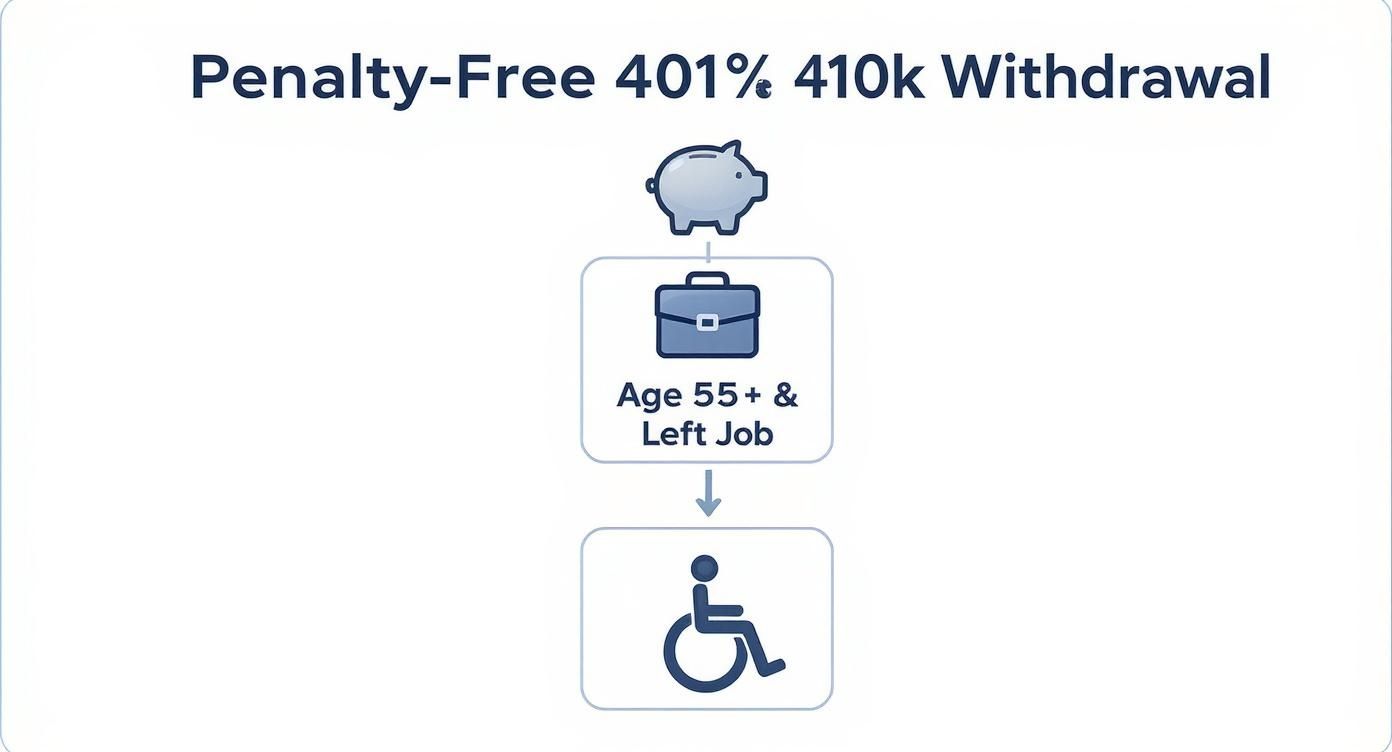
As you can see, separating from your job at age 55 or having a qualifying disability are other ways to access funds without penalty, but the 59½ rule is the most straightforward gate for penalty-free withdrawals.
Direct Distribution vs. IRA Rollover After 59 1/2
To make this choice clearer, let's put the two options side-by-side. The table below breaks down the key differences between taking a direct distribution and executing an IRA rollover after you've reached age 59½.
| Feature | Direct Distribution | IRA Rollover |
|---|---|---|
| Immediate Taxes | Yes. The full amount is taxable as ordinary income. | No. Taxes are deferred until you withdraw from the IRA. |
| Mandatory Withholding | Yes. A 20% federal withholding is required. | No. There is no mandatory withholding on a direct rollover. |
| Investment Options | N/A. The money is cashed out. | Vastly expanded. Access to stocks, bonds, ETFs, etc. |
| Growth Potential | Ends. The money is removed from its tax-advantaged account. | Continues. Your funds remain invested and can keep growing. |
| Withdrawal Control | N/A. It's a one-time lump sum event. | High. You control the timing and amount of future withdrawals. |
This comparison really highlights the long-term strategic advantages of a rollover. While a direct distribution gives you immediate cash, it often comes at the cost of higher taxes and lost future growth.
Making the Strategic Choice
For the vast majority of people, an IRA rollover is the smarter move once a 59 1/2 withdrawal 401k becomes available. It keeps your retirement savings working for you in a tax-friendly environment while giving you far more freedom and control over your investments.
A direct distribution really should be a last resort. It’s for situations where you have an immediate, unavoidable need for cash and have no other options. The tax hit and the loss of future growth are serious drawbacks that can compromise your financial security for years.
Figuring out how to take money from your 401(k) is a major financial milestone. By carefully weighing the instant cash of a distribution against the long-term power of a rollover, you can make a choice that truly aligns with your goals and builds a more secure retirement.
Common Questions About 401(k) Withdrawals After 59 ½
As you get closer to this major retirement milestone, it’s natural for questions to pop up about your 59 ½ withdrawal 401k options. Let's walk through some of the most common ones to clear things up.
Do I Have to Start Withdrawals at 59 ½?
No, not at all. Think of turning 59 ½ as getting a key to your retirement funds, not a mandate to start spending them. It’s simply the age the IRS allows you to access your 401(k) without that pesky 10% early withdrawal penalty.
The real deadline comes much later. The government requires you to start taking money out via Required Minimum Distributions (RMDs), but that doesn't kick in until your early 70s. This gives you plenty of extra years to let your investments continue to grow, tax-deferred.
Can I Withdraw From an Old Employer's 401(k)?
Yes, absolutely. The IRS 59 ½ rule is tied to your age, not your current job status. This means penalty-free access applies to every 401(k) you own, including those you left behind at previous jobs.
Once you hit this age, you’re free to take a distribution directly from that old plan. A more common strategy, however, is to roll those funds into an IRA, which often gives you more control and a wider array of investment choices.
The 59 ½ rule is universal for penalty assessment across both Traditional and Roth 401(k)s. It determines when you can access funds penalty-free, but the tax treatment remains fundamentally different between the two account types.
Does This Rule Apply to Both Traditional and Roth 401(k) Accounts?
Yes, the 59 ½ milestone is the magic number for penalty-free withdrawals from both Traditional and Roth 401(k)s. Where they part ways, though, is in how those withdrawals are taxed—and it’s a critical difference.
- Traditional 401(k): Money comes out penalty-free after 59 ½, but you'll pay ordinary income tax on every dollar you withdraw.
- Roth 401(k): As long as your account has been open for at least five years, your qualified withdrawals are completely tax-free and penalty-free.
Getting this distinction right is foundational to building a smart retirement income plan.
Trying to piece together complex retirement rules can feel overwhelming, but you don't have to go it alone. For expert guidance on structuring your retirement income, especially with strategies like a 72(t) SEPP, trust the specialists at Spivak Financial Group. Our team is ready to help you navigate your financial future.
Spivak Financial Group
8753 E. Bell Road, Suite #101
Scottsdale, AZ 85260
(844) 776-3728
https://72tprofessor.com