
When it comes to SIMPLE IRA transfer rules, everything hinges on one key concept: a mandatory two-year waiting period. This single timeline is the most critical factor in your decision-making, dictating where you can move your money and whether you’ll get hit with a hefty penalty. Get this part right, and the rest is straightforward.
Demystifying The SIMPLE IRA Transfer Rules

Navigating the world of retirement accounts can sometimes feel like you’re trying to learn a new language. Each plan, whether it's a 401(k) or a Traditional IRA, comes with its own vocabulary and a unique rulebook. The SIMPLE IRA is no exception, and its transfer rules are where it really stands apart.
You can think of a SIMPLE IRA as a specialized savings vehicle built to help small businesses offer retirement benefits without the administrative headaches of a traditional 401(k). For business owners, understanding these rules is a cornerstone of their overall retirement planning for business owners, as the plan is designed to be an accessible, streamlined option for both the company and its team.
Understanding Its Unique Design
The SIMPLE IRA (which stands for Savings Incentive Match Plan for Employees) is tailor-made for small businesses, and that’s reflected in who can offer one. An employer is eligible to set up a SIMPLE IRA plan only if they had 100 or fewer employees who earned at least $5,000 in the previous year. Another key requirement is that the employer can't offer any other qualified retirement plan during that same year.
This unique structure is what leads to some equally unique rules when you decide it's time to move your funds. Unlike a 401(k) you might roll over right after leaving a job, a SIMPLE IRA has a crucial waiting period that acts as a gatekeeper for your money.
The Core Concept: The Two-Year Rule
If you take away just one thing about simple ira transfer rules, make it the two-year waiting period. This rule is the foundation for every transfer and rollover decision you’ll make with these funds.
Here’s how it breaks down:
- The Clock Starts: The two-year countdown begins on the exact date your employer makes the very first contribution to your SIMPLE IRA account. It's a hard start date.
- During the First Two Years: Your options for moving the money are extremely limited. You can only transfer funds to another SIMPLE IRA. If you try to move it to a different type of account, like a Traditional IRA, you'll trigger a massive penalty.
- After the Two-Year Mark: The gates open. Once you cross that two-year threshold, the major restrictions are lifted. You gain the flexibility to transfer your funds to other retirement accounts, like a Traditional IRA or a 401(k), without facing that special penalty.
To make this crystal clear, here’s a quick summary of the key differences.
SIMPLE IRA Transfer Rules at a Glance
| Transfer Condition | Inside First 2 Years | After First 2 Years |
|---|---|---|
| To another SIMPLE IRA | Allowed, penalty-free | Allowed, penalty-free |
| To a Traditional IRA | Not allowed without a 25% penalty | Allowed, penalty-free |
| To a Roth IRA | Not allowed (requires conversion) | Allowed (conversion is taxable) |
| To a 401(k) or other qualified plan | Not allowed without a 25% penalty | Allowed, penalty-free |
As you can see, waiting for the two-year period to pass is almost always the right move.
Think of this two-year period as a kind of probationary period for your retirement money. During this time, the funds are committed to staying within the SIMPLE IRA ecosystem. Once you've passed the two-year mark, your money has earned the freedom to move to a much wider range of retirement destinations.
Understanding this timeline is the first and most important step. It helps you avoid costly mistakes and empowers you to plan your financial future with confidence, ensuring you don’t accidentally trigger a tax event that was entirely preventable.
The Critical 2-Year Waiting Period You Can't Ignore
When you’re dealing with a SIMPLE IRA, there’s one rule that towers above all others in importance: the two-year waiting period. This isn't just some minor detail buried in the fine print; it's the master timeline that dictates when and how you can move your money. Getting this wrong can cost you dearly.
Think of this period as a temporary lock on your funds. The entire point is to make sure the money stays put within the SIMPLE IRA world for a set amount of time. The clock starts ticking on the exact date your employer drops that very first contribution into your account. It doesn't matter when you were hired or when you became eligible—all that matters is the date of that first deposit.
Why This Timeline Is So Important
Ignoring this two-year rule is one of the most expensive mistakes you can make with a retirement account. If you try to move your SIMPLE IRA funds to a different type of account, like a Traditional IRA or a 401(k), before this period is up, you’re in for a world of hurt.
The penalty is no joke. Most early withdrawals from retirement plans get hit with a 10% penalty. But for a premature SIMPLE IRA transfer? That penalty skyrockets to a massive 25%. And that's on top of the regular income taxes you'll owe on the distribution. Together, they can easily vaporize a huge chunk of your savings. This is why knowing your specific start date is absolutely critical.
How the 25% Penalty Works in the Real World
Let's walk through a quick example to see the financial damage firsthand.
Imagine Sarah has $20,000 in her SIMPLE IRA. Her account has only been open for one year, but she's eager to consolidate her finances and wants to move the money into her Traditional IRA. Because she's still inside that two-year window, the IRS considers this a premature distribution.
- Penalty Amount: $20,000 x 25% = $5,000
- Taxable Income: $20,000
- Income Tax (assuming a 22% bracket): $20,000 x 22% = $4,400
Just like that, Sarah would lose $9,400 of her retirement savings to taxes and penalties—that’s nearly half her account! If she had just waited one more year, she could have transferred the entire $20,000 without losing a dime to that nasty $5,000 penalty.
IRS Rules on Early Withdrawals
The IRS is crystal clear on this. The SIMPLE IRA transfer rules are built around this two-year period, which directly impacts how penalties are calculated for early withdrawals or rollovers. When you take money out within two years of that first contribution, the IRS slaps on a 25% additional tax on top of your regular income tax. This is far more severe than the standard 10% penalty for other accounts if the withdrawal happens before age 59½.
To see the rules straight from the source, you can explore the official IRS guidelines on SIMPLE IRA withdrawals.
The screenshot below from the IRS website drives the point home, highlighting the difference in penalty rates.
This visual confirms that the penalty jumps from the standard 10% to 25% specifically for distributions made during that initial 2-year period. It’s a timeline you have to respect.
Key Takeaway: The two-year waiting period is not a suggestion; it's a hard-and-fast rule with huge financial consequences. It starts with the very first contribution, and any transfers to non-SIMPLE IRAs before it ends will trigger a 25% penalty plus income tax.
By simply being patient and waiting for this period to pass, you unlock the freedom to move your funds to other retirement accounts, like a Traditional IRA, without getting hit with that punitive penalty. It’s all about timing, and getting it right can save you thousands of dollars and keep your retirement goals on track.
How to Navigate Permitted Transfers and Rollovers
Once you've hit that two-year anniversary from your first SIMPLE IRA contribution, your options really open up. The landscape of SIMPLE IRA transfer rules changes dramatically, giving you a lot more flexibility to manage your retirement savings the way you want. The first step is getting clear on the difference between a transfer and a rollover.
Think of a transfer as moving your account from one house to another. It’s still the same account, just with a new address. This is often called a trustee-to-trustee transfer because the money moves directly between financial firms, and you never actually handle the funds. For example, moving your SIMPLE IRA from Brokerage A to Brokerage B is a simple transfer.
A rollover is more like changing the entire nature of the account. This is what you do when you move money from your SIMPLE IRA into a completely different type of retirement plan, like a Traditional IRA, but only after that two-year waiting period is up. If you want to get into the nitty-gritty, we break down all the mechanics in our guide on what is a rollover.
Moving Funds From One SIMPLE IRA to Another
The most straightforward move you can make is a direct transfer from your current SIMPLE IRA to another one at a different company. The great thing about this is that it's permitted at any time, even if you’re still within that initial two-year window.
So, why would you do this? A few common reasons pop up all the time:
- Lower Fees: You’ve shopped around and found another provider with a much better fee structure.
- Better Investment Options: The new place offers a wider menu of investment choices that are a better fit for your financial goals.
- Account Consolidation: You’re tired of juggling accounts everywhere and want to bring everything under one roof for simpler management.
Because the funds go straight from one trustee to the next and the account type doesn't change, it's not a taxable event. The IRS doesn't even need to be notified. It’s a clean, penalty-free way to switch providers.
This image gives you a great visual of the key steps to pull off a smooth account transfer.
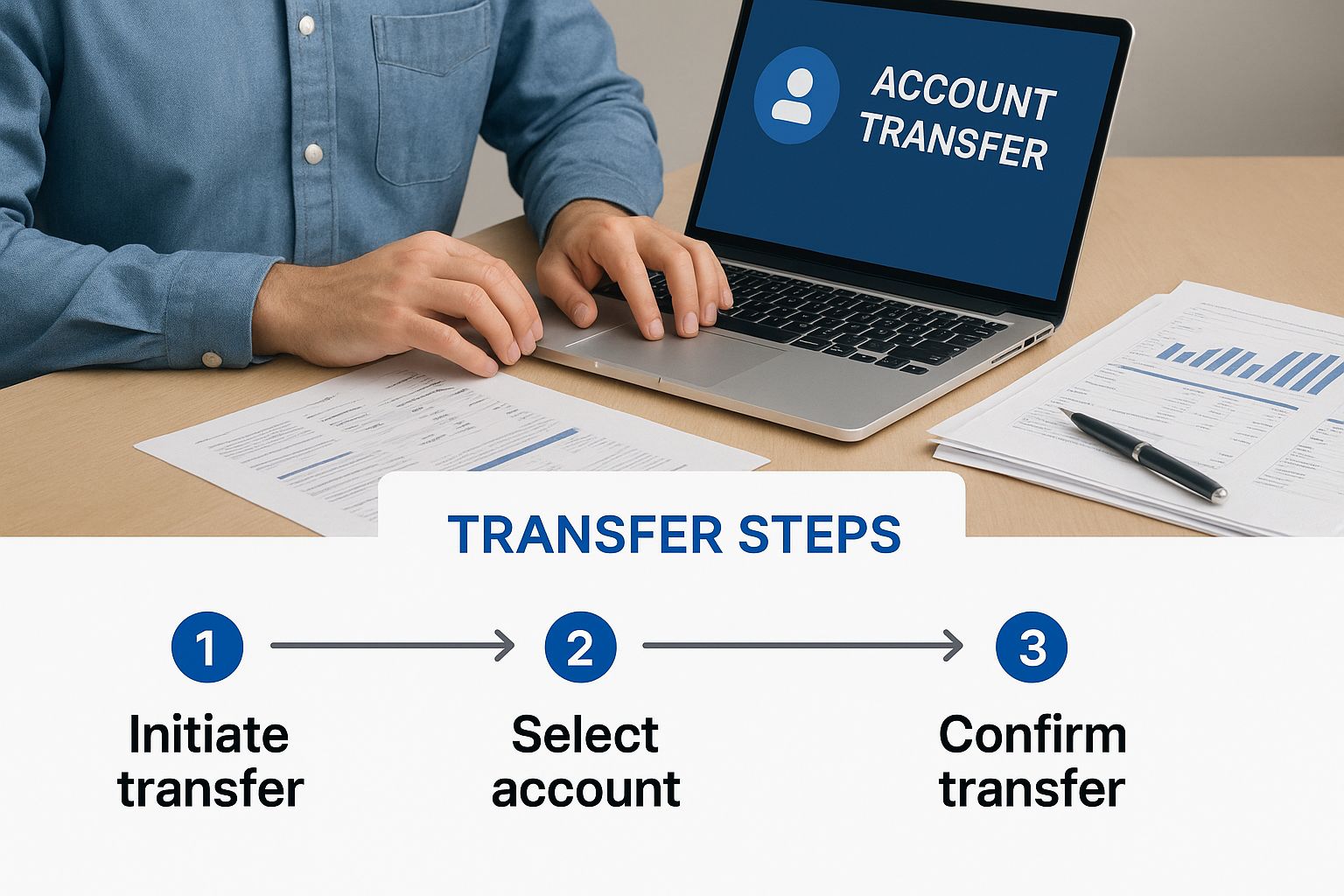
As you can see, a successful transfer all comes down to clear communication and getting the paperwork right between both financial institutions.
Rolling Over to a Traditional IRA After Two Years
This is the big one. Once you're past that two-year mark, you unlock the ability to roll your SIMPLE IRA into a Traditional IRA without getting hit with that nasty 25% penalty. This is a game-changer, opening up a much larger universe of investment options and making it easier to consolidate various retirement accounts.
The process itself is pretty straightforward:
- Confirm Your Eligibility: Before you do anything, double-check the date of the very first contribution to your account. Make sure at least two full years have passed.
- Open a Traditional IRA: If you don't already have one, you'll need to open a Traditional IRA at the brokerage or bank of your choice.
- Initiate the Rollover: Get in touch with your current SIMPLE IRA provider to kick off the process. The best way to do this is with a direct rollover, where they send the money right to your new IRA custodian. It’s the safest and cleanest method.
A direct rollover is your best friend in this process. It prevents potential tax withholding issues and eliminates the risk of missing the 60-day deadline associated with indirect rollovers, where a check is made out to you.
Why You Generally Cannot Move Funds Into a SIMPLE IRA
It's also critical to understand that money in the retirement world often flows on a one-way street. SIMPLE IRAs are designed to accept contributions from an employer's plan, but they generally cannot accept rollovers from other retirement plans like Traditional IRAs or 401(k)s.
This restriction is there to keep the plan, well, "simple." Allowing outside funds to pour in would complicate the administration and could easily violate the plan's specific rules. So, while you can move money out of a SIMPLE IRA after two years, you almost never can move other retirement funds in. It's helpful to understand how rollovers work for other accounts, as the tax implications can be similar. For instance, knowing the rules for converting a 401k to an annuity can offer some valuable perspective on these types of account movements.
Avoiding Costly Tax Implications and Penalties
Every move you make with your SIMPLE IRA has financial consequences. Think of it like a chess game: a thoughtful move protects your assets, while a hasty one can leave you open to attack. This section is your guide to understanding the tax and penalty landscape, making sure you can navigate simple ira transfer rules without any costly surprises.
It's not just about the particularly harsh 25% penalty for moving money too soon. Regular income tax is a constant player in the game. Any money you withdraw or roll over from a pre-tax account like a SIMPLE IRA is generally treated as ordinary income for that year, which can significantly bump up your overall tax bill.
Decoding the Financial Consequences
The key to avoiding penalties is knowing how the IRS views different actions. The two factors that matter most are always the two-year waiting period and your age. Getting either of these wrong can turn a simple transaction into a massive financial headache.
For example, a withdrawal before age 59½ typically comes with a 10% early withdrawal penalty. But as we've seen with SIMPLE IRAs, that penalty skyrockets to a staggering 25% if it happens within the first two years of your plan's start date. Many people find themselves needing guidance on how to cash out their retirement funds without penalties, and it always comes down to careful planning.
The core principle is straightforward: All distributions from a SIMPLE IRA are taxed as ordinary income. The penalties are slapped on in addition to this tax, making a misstep incredibly expensive. A proper rollover, however, is a non-taxable event that keeps the tax-deferred status of your money intact.
While you're thinking about taxes, it's also smart to be aware of broader strategies to protect retirement savings from IRS levies. Protecting your nest egg is a multi-faceted process that goes beyond just avoiding early withdrawal penalties.
Comparing Different Scenarios
Seeing the numbers side-by-side makes the stakes crystal clear. To really drive the point home, let's look at what happens to a $30,000 account balance under different circumstances. We'll assume a 22% federal income tax bracket for these examples.
Tax and Penalty Scenarios for SIMPLE IRA Movements
This table breaks down how quickly a mistake can erode your savings, and how a correct move preserves it entirely.
| Action | Timing | Age | Penalty | Income Tax |
|---|---|---|---|---|
| Withdrawal | Within 2 Years | Under 59½ | $7,500 (25%) | $6,600 (22%) |
| Withdrawal | After 2 Years | Under 59½ | $3,000 (10%) | $6,600 (22%) |
| Withdrawal | Any Time | Over 59½ | $0 (0%) | $6,600 (22%) |
| Proper Rollover | After 2 Years | Any | $0 (0%) | $0 (Deferred) |
As the table shows, a premature withdrawal inside that two-year window could mean losing almost half your money to taxes and penalties. In stark contrast, by waiting and performing a proper rollover, you preserve the entire $30,000 for your retirement.
The financial difference is enormous, and it's completely within your control. This direct comparison highlights why sticking to the rules isn't just a suggestion—it's essential for protecting and growing your hard-earned retirement funds.
Common Mistakes in SIMPLE IRA Transfers

Knowing the simple ira transfer rules is one thing, but seeing how they can go wrong in the real world is a whole different ballgame. The best way to sidestep a costly error is to learn from the missteps others have already made.
These common mistakes often come from small misunderstandings that, unfortunately, carry big financial consequences. By spotting these pitfalls ahead of time, you can make sure your retirement funds are handled correctly, keeping your savings safe and sound—and away from the prying eyes of the IRS.
Miscalculating the Two-Year Start Date
One of the most frequent and painful errors is getting the start date of the two-year waiting period wrong. It’s an easy mistake to make. You might think the clock starts on your hire date or when you first became eligible for the plan.
But here’s the reality: the clock officially begins on the date the very first contribution is deposited into your account. That’s it. That one specific date is the only one that matters. Getting this wrong and trying to move your money to a non-SIMPLE IRA even one day too early can trigger a brutal 25% penalty.
What Not to Do: Never guess or estimate your start date based on memory.
Actionable Solution: Always confirm the exact date of your first contribution. Dig up your old account statements or get on the phone with your plan administrator to get the precise date.
Attempting a Direct Rollover to a Roth IRA
The dream of getting funds into a tax-free Roth IRA is a powerful one, but you absolutely cannot roll a SIMPLE IRA directly into a Roth IRA. It's like trying to mix oil and water. These accounts have completely different tax treatments—one is pre-tax (the SIMPLE), and the other is post-tax (the Roth). There’s just no direct path between them.
Trying to force this move will get rejected by the financial institutions. Or worse, it could be processed as a full-blown taxable distribution, sticking you with a massive tax bill and potential penalties.
- The Wrong Path: SIMPLE IRA → Direct Rollover → Roth IRA (This is not allowed.)
- The Correct Path: SIMPLE IRA → Rollover (after 2 years) → Traditional IRA → Roth Conversion (This is a taxable event, but it's the right way to do it.)
This two-step process is the only compliant way to get your SIMPLE IRA money into a Roth.
Missing the 60-Day Indirect Rollover Deadline
Direct, trustee-to-trustee rollovers are always the safest bet. But sometimes, an indirect rollover is the only option. In this scenario, a check is made out directly to you, and the clock starts ticking. You have exactly 60 days to deposit that full amount into another qualified retirement account.
This deadline is non-negotiable and the IRS is notoriously strict about it. If you miss it by even one day, the entire amount is treated as a taxable distribution. You'll owe income tax on the whole chunk of cash, and if you're under 59½, you'll get hit with early withdrawal penalties, too.
- Mistake: You get a check in the mail, set it aside, and completely forget to redeposit it within the 60-day window.
- Solution: Just opt for a direct rollover whenever you can. It completely eliminates this risk. If you absolutely have to do an indirect rollover, set a dozen calendar reminders and deposit those funds the day you get them.
By keeping these common slip-ups in mind—misjudging the start date, trying an illegal rollover, or fumbling the 60-day rule—you can navigate your SIMPLE IRA transfer with the confidence and precision of a pro.
Frequently Asked Questions About SIMPLE IRA Transfers
When you're dealing with retirement accounts, it's the little details that can trip you up. The SIMPLE IRA transfer rules are no exception, and a few key questions come up over and over again. Let's clear the air on these common points of confusion so you can manage your retirement savings with confidence.
What Happens if I Leave My Job Before the 2 Years Are Up?
This is a big one. If you leave your employer, your SIMPLE IRA is yours to keep. The important thing to know is that the two-year clock doesn't stop or reset. It keeps ticking from the date your very first contribution was made, no matter what your job status is.
You still have to wait for that two-year period to finish before you can roll the funds into a Traditional IRA or 401(k) without getting hit with that steep 25% penalty. However, you can always move the money to another SIMPLE IRA at a different financial institution anytime you want.
Can I Roll a SIMPLE IRA Directly Into a Roth IRA?
The short answer is no. A direct rollover from a pre-tax SIMPLE IRA to a post-tax Roth IRA isn't allowed by the IRS. This is a common mix-up because the tax treatments of the accounts are polar opposites.
To make it happen, you have to follow a specific two-step process. First, wait for the two-year holding period to end. Once it has, you can perform a valid rollover into a Traditional IRA. From there, you can execute a Roth conversion, which is a completely separate (and taxable) event. This is the only approved way to get it done, and it requires some careful tax planning. Many people wonder about the specifics of moving retirement funds, and you can learn more about the decision process by exploring if you have to rollover funds at all.
Key Insight: The two-year rule is a one-time gate. It starts on the date of the very first contribution and applies to the whole account. Once two years have passed from that initial deposit, all the money in the account is free from the special transfer restrictions.
Does the 2-Year Rule Apply to Every Contribution?
Thankfully, no. This is a critical detail that saves a lot of headaches. The two-year period is not a rolling timeline that resets every time you or your employer make a deposit.
The clock starts just once: on the day the first dollar was deposited into your account. After two years from that single date, every dollar in that account—including all later contributions and any earnings—is eligible to be rolled over into other retirement plans like a Traditional IRA.
How Can I Confirm the Start Date of My 2-Year Period?
Don't guess. Estimating your start date is a recipe for a costly penalty. The most reliable way to find this crucial date is to dig up your old account statements.
Look for the transaction date of the first-ever deposit, whether it came from you or your employer. If you can't track down the statements, your next best move is to call your plan administrator or the brokerage holding the IRA. They are required to keep these records and can give you the exact date you need.
At Spivak Financial Group, we help clients navigate complex retirement rules to unlock their financial potential. If you're looking to access your retirement funds early without penalties, explore how a 72(t) SEPP plan could be the right solution for you. Learn more at 72tProfessor.com.
Spivak Financial Group
8753 E. Bell Road
Suite #101
Scottsdale, AZ 85260
(844) 776-3728