
When you're mapping out your retirement, one question inevitably pops up: how exactly are Roth IRA distributions taxed?
The answer is beautifully simple and incredibly powerful. Qualified distributions from a Roth IRA are 100% tax-free. This single benefit is the main reason so many people use this account to build wealth for their golden years.
The Promise of Tax-Free Retirement Income
Picture a retirement account that acts like a tax-proof greenhouse for your money. Every single dollar your investments earn is shielded from the IRS, both while it's growing and when you eventually take it out. That's the fundamental promise of the Roth IRA, a game-changer in the retirement savings world.
Brought into existence by the Taxpayer Relief Act of 1997, the Roth IRA flipped the old retirement model upside down. Instead of getting a tax break now and paying taxes later (the way a Traditional IRA works), you put in after-tax money. In return, the government agrees to keep its hands off your qualified withdrawals down the road.
If you want to dig deeper into how these accounts stack up, check out our comprehensive guide comparing the IRA and Roth IRA. Understanding this distinction is absolutely critical for anyone serious about maximizing their retirement income.
What Makes a Distribution "Qualified"
To unlock that incredible tax-free benefit, your withdrawal has to be "qualified." This isn't just a random label; it means you've satisfied two specific conditions laid out by the IRS. Think of them as the two keys you need to open your tax-free treasure chest.
- The Age Requirement: You have to be at least age 59½ when you take the money out.
- The Five-Year Rule: Your Roth IRA needs to have been open for a minimum of five tax years. This clock starts ticking on January 1st of the very first year you contributed.
When you hit both of these milestones, every penny you withdraw—your original contributions and all the investment earnings—comes to you without a federal tax bill. Qualified Roth IRA distributions are completely tax-free and penalty-free. No income tax, no early withdrawal penalties. It's a unique advantage that offers amazing predictability for your retirement budget.
To give you a quick visual, here’s how qualified and non-qualified distributions stack up.
Qualified vs. Non-Qualified Roth IRA Distributions at a Glance
This table offers a snapshot of the tax and penalty implications for different types of Roth IRA withdrawals, making it easy to see why meeting the "qualified" criteria is so important.
| Distribution Type | Federal Income Tax | 10% Early Withdrawal Penalty |
|---|---|---|
| Qualified Distribution | None on contributions or earnings | None |
| Non-Qualified Distribution | None on contributions, Taxable on earnings | Applies to the earnings portion if under age 59½ |
As you can see, the difference is stark. Getting this right is the key to maximizing your Roth IRA's power.
The whole point of a Roth IRA is to build a source of retirement income that's completely predictable and safe from future tax hikes. By mastering the rules for qualified distributions, you're taking direct control of your financial future.
If you don't meet these conditions, your withdrawal becomes "non-qualified." This can trigger both income taxes and penalties, but only on the earnings portion of your withdrawal. We'll break down exactly how that works in the next sections to make sure you know how to navigate the rules successfully.
Decoding the Roth IRA Five-Year Rule
When it comes to taxes on Roth IRA distributions, nothing trips people up more than the five-year rule. It’s a common point of confusion. Most people assume it's a single countdown, but that’s not quite right.
A better way to think about it is having several different stopwatches, with each one tied to a different kind of money in your Roth account. Getting a handle on how these clocks work is the key to unlocking truly tax-free withdrawals in retirement.
The first and most important clock is for your original contributions. This five-year holding period starts on January 1st of the tax year you first put money into any Roth IRA. Once that clock hits five years and you’re over age 59½, all the earnings in your account become "qualified," meaning you can pull them out completely tax-free.
But here’s the tricky part: a completely separate five-year rule applies to each Roth conversion. This is where so many investors get tangled.
The Two Types of Five-Year Rules
To manage your Roth IRA properly, you need to track two very different timelines. One is for the account as a whole, and then you have a separate one for every conversion you make.
- The Overall Account Holding Period: This is the main five-year rule that dictates when your earnings can be withdrawn tax-free. It kicks off on January 1st of the year you made your very first Roth IRA contribution. Once you’ve met this rule (and you’re over 59½), your earnings are good to go.
- The Conversion Waiting Period: Each time you move money from a Traditional IRA to a Roth IRA, that specific chunk of converted money starts its own five-year clock. This rule is there to stop people from converting pre-tax money and immediately withdrawing it tax-free.
This infographic lays out the major milestones on the path to tax-free Roth IRA withdrawals in a simple, visual way.
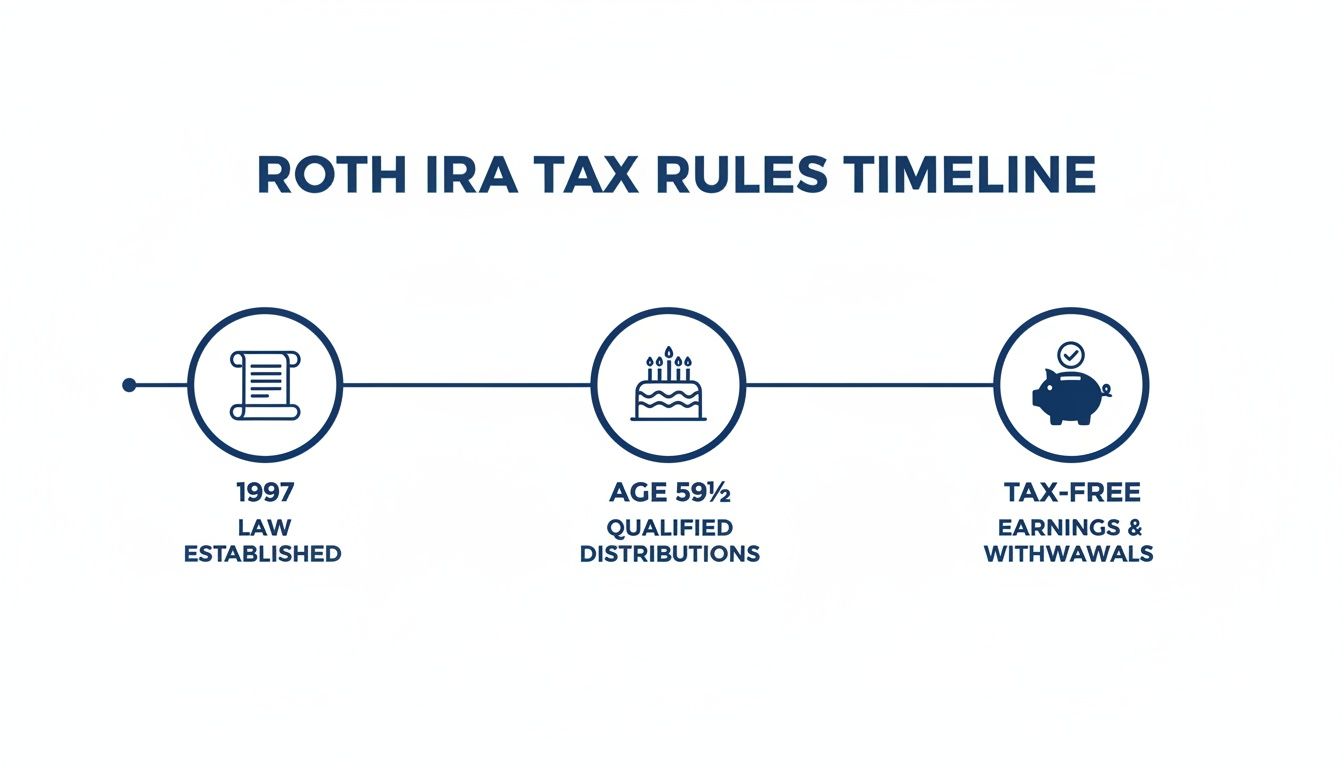
As you can see, the path is pretty clear—from the law's establishment in 1997 all the way to reaching age 59½ and achieving that tax-free distribution status.
The Roth IRA has become wildly popular since it was created. It was enacted in 1997 with a small $2,000 contribution cap, but it really took off after 2010 when the rules around conversions were relaxed. By 2020, Roth IRA assets had ballooned to an incredible $1.2 trillion, which speaks volumes about their value in tax planning. The huge advantage is that qualified distributions are totally tax-free, which is a world away from traditional IRA withdrawals where every dollar is taxed. You can read the full study on Roth IRA trends to see the research behind this growth.
How the Timelines Work in Practice
Let's walk through a real-world example to see how these clocks run at the same time.
Meet Sarah. She's 55 and wants to build a source of tax-free income for her retirement.
- 2020: She opens her very first Roth IRA and makes a contribution. This starts her main five-year clock for earnings. It began on January 1, 2020, and will be satisfied on January 1, 2025.
- 2022: Sarah decides to convert $50,000 from her Traditional IRA into her Roth. This specific $50,000 now has its own five-year waiting period, which won't be satisfied until January 1, 2027.
- 2024: She does another conversion, this time for $30,000. This starts yet another five-year clock, which will be satisfied on January 1, 2029.
Fast forward to 2029. Sarah is now 64. By this point, all her clocks have run their course. She’s over 59½, her main account has been open for more than five years, and both of her conversions have met their individual waiting periods. Now, she can access every single dollar—her original contributions, the converted amounts, and all the earnings—completely free of taxes and penalties.
One of the biggest myths is that a new conversion resets the main five-year clock on your account. It absolutely does not. Each conversion just adds a new, parallel timeline that you have to track for that specific pot of money.
This is exactly why keeping good records is so critical. You need to know the date of your first contribution and the date of every single conversion. For a deeper dive into tracking different money types in your account, you can learn more about your IRA basis in our detailed article.
Getting these timelines right is the foundation for successfully handling the rules on taxes on Roth IRA distributions. Next up, we’ll look at how the IRS decides which money comes out first, adding another strategic layer to your planning.
How the IRS Views Your Money: The Roth Withdrawal Order
To really get a handle on the taxes on Roth IRA distributions, you have to see your account the way the IRS does. When you pull money out, it's not just from one big pot. Instead, the IRS has a very strict set of "ordering rules" that say exactly which bucket of money comes out first.
Getting this sequence right is critical because it’s one of the most powerful and flexible features of a Roth IRA. It's the very thing that gives you options, especially when life throws a curveball and you need your money sooner than expected.

It helps to picture your Roth IRA as a stack of three glass jars. The IRS makes you empty them from the bottom up, in a precise order. You don’t get to pick and choose which jar you dip into.
The First Layer: Contributions
The very first money you can ever touch is your pile of direct contributions. This is the cash you personally put into the account over the years, after you already paid taxes on it.
This brings us to the golden rule of Roth IRAs: You can withdraw your regular contributions at any time, for any reason, completely tax-free and penalty-free.
Because you’ve already been taxed on this money, the IRS can’t touch it again. It doesn’t matter if you're 35 or 65, or if your account has been open for one year or twenty. Your contributions are always yours to take back without any strings attached.
This single feature transforms the Roth IRA into an incredibly versatile financial tool. While its primary job is funding your retirement, the ability to pull out contributions acts as a powerful emergency fund for major life events—a concept we’ll dig into later.
This rule is a massive leg up over Traditional IRAs, where almost any withdrawal before retirement age gets hit with both income taxes and penalties.
The Second Layer: Conversions
Only after you’ve taken out every single dollar of your direct contributions can you start tapping into the second layer: converted funds. This is money you rolled over from a pre-tax account, like a Traditional IRA or an old 401(k).
The IRS tracks these rollovers on a first-in, first-out (FIFO) basis. Put simply, the first conversion you ever made is the first one you withdraw from. If you did several conversions over the years, you have to take them out chronologically.
- 2018 Conversion: You’d withdraw from this one first.
- 2020 Conversion: This would be tapped second.
- 2023 Conversion: This comes out third.
Now, you generally won't pay income tax on the principal amount of these conversions again (since you paid tax when you did the rollover). However, you could still face a 10% penalty if you withdraw it before that specific conversion's five-year holding period is up. This is the IRS’s way of stopping people from using conversions as a backdoor way to get cash out of retirement accounts without penalty.
The Final Layer: Earnings
The absolute last money to come out of your Roth IRA is your investment earnings. This top layer is all the growth—the interest, dividends, and capital gains your investments have racked up over time.
You can only get to this layer after you've completely drained all your contributions and all your converted funds.
This is the part of your account with the tightest restrictions. Withdrawing your earnings is what can trigger taxes and penalties if your distribution isn't "qualified." As we discussed earlier, a qualified distribution means you’re at least 59½ and you’ve met the account's main five-year rule.
This mandated withdrawal order—contributions, then conversions, then earnings—is actually incredibly generous. The IRS forces you to use your most flexible, tax-free money first, while the potentially taxable earnings stay sheltered until the very end. This built-in hierarchy is a cornerstone of smart Roth IRA planning.
Navigating Penalties on Non-Qualified Distributions
While the goal is always a tax-free qualified distribution, life is unpredictable. Sometimes you need to tap into your retirement funds sooner than planned. When this happens, your withdrawal is considered "non-qualified," which can trigger both income taxes and a pesky 10% early withdrawal penalty.
Understanding exactly how these consequences apply is crucial for managing your finances during an emergency. A non-qualified distribution happens when you pull money from your Roth IRA before meeting both key requirements: reaching age 59½ and satisfying the five-year rule.
But remember the IRS ordering rules? They provide a critical buffer. Because your direct contributions always come out first, you can access that portion of your money without any tax or penalty worries. The trouble starts when you have to dip into the next layers of your account—converted funds and earnings.
The 10% Early Withdrawal Penalty Explained
Think of the 10% penalty as the IRS's way of discouraging you from using retirement funds for non-retirement purposes. This penalty is slapped on top of any regular income tax you might owe on the withdrawal, making it a double whammy.
Here’s how it typically breaks down across the different layers of your Roth IRA funds:
- Contributions: As we've covered, these are always safe. You can withdraw them anytime, for any reason, with no tax and no penalty.
- Conversions: If you withdraw converted funds before that specific conversion's five-year holding period is up and you are under age 59½, the taxable portion of that conversion gets hit with the 10% penalty.
- Earnings: This is the most sensitive layer. Pull out earnings before you turn 59½, and that money is subject to both ordinary income tax and the 10% penalty.
This structure is a huge advantage. Taxable IRA distributions—mostly from traditional IRAs—hit a staggering $257.5 billion in 2016, a big jump from $213.6 billion in 2013. You can explore more Federal Reserve data on IRA distributions to see how taxes chip away at retirement savings, which really highlights the value of the Roth's tax-free design.
To make this clearer, let's look at how the IRS treats withdrawals from each source of funds when they are considered non-qualified.
Tax Treatment of Roth IRA Withdrawal Types
| Source of Funds | Taxable? | Subject to 10% Penalty? |
|---|---|---|
| Contributions | No | No |
| Conversions (Taxable portion) | Yes (if 5-year rule not met) | Yes (if under 59½) |
| Conversions (Nontaxable portion) | No | No |
| Earnings | Yes | Yes (if under 59½) |
This table shows why the ordering rules are your best friend. They ensure you can pull out your tax-free, penalty-free contributions first, shielding you from immediate consequences.
Common Scenarios for Non-Qualified Withdrawals
Let's walk through a practical example. Imagine Mark is 45 years old. His Roth IRA holds $40,000 in contributions and $10,000 in earnings. He needs to pull out $45,000 for an unexpected major expense.
- The first $40,000 he withdraws is treated as coming from his contributions. This chunk is completely tax-free and penalty-free.
- To get the full $45,000, the next $5,000 must come from his earnings. Because he is under 59½, this $5,000 is a non-qualified distribution.
- The result? He will owe ordinary income tax on that $5,000 plus a $500 penalty (10% of $5,000).
This example perfectly illustrates how the ordering rules shield a large portion of his withdrawal, but not all of it.
Key Exceptions That Waive the 10% Penalty
Fortunately, the IRS understands that true emergencies happen. They've built in several important exceptions that let you avoid the 10% penalty on early distributions, even if you are under age 59½. It’s important to remember that these exceptions only waive the penalty—you will still owe income tax on any withdrawn earnings.
The ability to access your Roth IRA funds under specific circumstances provides a crucial safety net. Knowing these exceptions can save you a significant amount of money when you need it most.
Here are some of the most common penalty exceptions:
- First-Time Home Purchase: You can withdraw up to a $10,000 lifetime limit from your earnings penalty-free to buy, build, or rebuild a first home.
- Disability: If you become totally and permanently disabled, you can take distributions without the 10% penalty.
- Major Medical Expenses: You can take penalty-free withdrawals for unreimbursed medical expenses that exceed 7.5% of your adjusted gross income (AGI).
- Higher Education Costs: Funds can be used penalty-free to pay for qualified higher education expenses for yourself, your spouse, your children, or your grandchildren.
- Substantially Equal Periodic Payments (SEPP): This is a powerful strategy, often called a 72(t) plan, that lets you take a series of penalty-free withdrawals before age 59½. If early retirement is on your radar, it's worth exploring these options for penalty-free IRA withdrawals in more detail.
These exceptions add another layer of flexibility to your Roth IRA, making it a valuable tool not just for retirement, but for navigating some of life's biggest financial hurdles.
Strategic Planning for Tax-Free Retirement Income
Knowing the rules for taxes on Roth IRA distributions is one thing, but actually using them to build a powerful retirement strategy is where the real magic happens. A Roth IRA is much more than a simple savings account; it's your personal tool for creating a steady, predictable stream of tax-free income right when you need it most. With a bit of foresight, you can fundamentally change your financial picture in retirement.
This goes way beyond just making contributions and hoping for the best. Smart planning involves actively managing your income sources to slash your tax bill—not just on the withdrawals themselves, but across your entire financial life, including how much of your Social Security and Medicare you get to keep.

Building a Roth Conversion Ladder
For anyone dreaming of retiring early, the Roth conversion ladder is one of the most powerful plays you can make. This technique sets up a reliable pipeline of tax-free cash that you can tap into before age 59½ without getting hit by that painful 10% penalty. It’s a methodical process that turns the five-year rule for conversions into your greatest asset.
Picture it like building a bridge to your future self, one plank at a time. Each year, you convert a set amount of money from a pre-tax account, like a Traditional IRA, over to your Roth IRA. You'll pay ordinary income tax on that conversion in the year you do it.
That converted cash then starts its own five-year clock. If you repeat this process for five years straight, by year six, the money from your very first conversion is fully "seasoned" and ready to be withdrawn. From then on, a new batch of tax-free and penalty-free money becomes available every single year.
This creates a stable, dependable income stream completely independent of the government's retirement age rules. It's no wonder this is a foundational strategy for members of the Financial Independence, Retire Early (FIRE) movement.
A Roth conversion ladder is the ultimate forward-thinking move. It requires patience and planning, but it empowers you to methodically construct a tax-free income source on your own timeline, not the IRS's.
Managing Your Overall Taxable Income
The beauty of tax-free Roth withdrawals goes far beyond just the money you take out. By strategically pulling from your Roth IRA, you gain incredible control over your provisional income—that's the magic number the IRS uses to decide if your Social Security benefits get taxed.
The formula for provisional income is:
- Your Modified Adjusted Gross Income (MAGI)
- Plus 50% of your Social Security benefits
- Plus any tax-exempt interest you have
Here’s the key: qualified Roth IRA distributions don't count towards your MAGI, making them completely invisible in this calculation. This means you can pull cash from your Roth to supplement your lifestyle without accidentally pushing your income over the thresholds that force you to pay taxes on your Social Security. For many folks, this could be the difference between paying taxes on up to 85% of their benefits and paying nothing at all.
And there's more. Keeping your income low can also save you a bundle on Medicare Part B and Part D premiums. These costs are subject to the Income-Related Monthly Adjustment Amount (IRMAA), which tacks on a surcharge if your income is too high. Using tax-free Roth money helps you stay under those IRMAA cliffs, keeping more money in your pocket instead of sending it to the government for healthcare.
Pairing a Roth IRA with a 72(t)/SEPP Plan
If an early retirement is in your plans, combining a Roth IRA with a Substantially Equal Periodic Payment (SEPP) plan—often called a 72(t) plan—creates an incredibly flexible and resilient income strategy. At Spivak Financial Group, we often see these two tools as the perfect pair.
A 72(t)/SEPP plan lets you take penalty-free distributions from a pre-tax IRA before you hit age 59½, but it’s very rigid. The payments must be a set amount and continue for at least five years or until you turn 59½, whichever is longer. You can't deviate.
This is where your Roth IRA becomes your secret weapon for flexibility. While the 72(t) provides a steady, predictable paycheck for your core expenses, your Roth can act as a financial shock absorber. If a big, unexpected cost pops up—a leaky roof or a surprise medical bill—you can simply withdraw your Roth contributions tax-free and penalty-free. This lets you handle the emergency without touching your SEPP schedule and breaking the strict 72(t) rules, which would trigger a cascade of retroactive penalties.
Common Questions on Roth IRA Distribution Taxes
Even after you get the hang of the basic rules, a few practical questions almost always pop up when it comes time to actually take money out of your Roth IRA. Let's tackle some of the most common real-world scenarios to clear up any lingering confusion and help you move forward with confidence.
Do I Have to Pay State Taxes on My Roth IRA Distributions?
Generally, the answer is a relieving "no." The vast majority of states follow the federal government's lead when it comes to Roth IRAs. So, if your withdrawal is a qualified, federally tax-free distribution, it’s almost certain to be tax-free at the state level, too.
But this isn't a universal guarantee. A handful of states play by their own rules and don't fully conform to federal tax law on retirement accounts. State tax codes are also known to change. It's always a smart move to check in with a tax professional who's an expert in your specific state’s laws to make sure you don't get hit with an unexpected tax bill.
How Do I Report Roth IRA Distributions on My Tax Return?
This is a critical step that trips a lot of people up, especially since the money is often tax-free. Anytime you take a distribution from a Roth IRA, your brokerage or financial institution is required to send you Form 1099-R, which details the withdrawal.
You absolutely must report this distribution on your federal tax return, even if you don't owe a single penny in tax. You'll do this using IRS Form 8606, "Nondeductible IRAs." Don't let the name fool you—Part III of this form is specifically for reporting distributions from Roth IRAs. Filling this out correctly is how you officially prove to the IRS that your withdrawal was qualified and tax-free, preventing any automated flags or inquiries down the road.
Think of it this way: Proper reporting isn't optional. Filing Form 8606 correctly is your official paper trail, proving to the IRS that your distribution is qualified and that no tax is due.
What Are the Tax Rules for an Inherited Roth IRA?
Inheriting a Roth IRA comes with its own unique set of rules. The good news for a beneficiary is that distributions are typically tax-free, as long as the original owner had already met their five-year holding period. Better yet, the age 59½ requirement is waived for beneficiaries.
However, the SECURE Act threw a major curveball for most non-spouse beneficiaries. Under the new law, you are generally required to withdraw all the funds from the inherited account within 10 years of the original owner's death. While these distributions are still tax-free, failing to empty the account by that 10-year deadline triggers a massive penalty—a steep 50% of the amount that should have been withdrawn.
This makes strategic planning for an inherited Roth absolutely essential. You have the flexibility to take money out whenever you want during that 10-year window, but you have to make sure the account balance hits zero by the final deadline.
Can I Use My Roth IRA as an Emergency Fund?
Yes, you can, and this is arguably one of the Roth IRA's most powerful features. Because you can withdraw your direct contributions—the money you put in yourself—at any time, for any reason, tax-free and penalty-free, the account can double as a fantastic backup emergency fund.
This provides an incredible layer of financial security. If a major, unexpected expense pops up, you have a pool of money you can tap into without getting hammered by taxes or penalties.
But you have to approach this with caution. Remember, the primary job of your Roth IRA is to fund your retirement. Every dollar you pull out is a dollar that's no longer compounding and growing tax-free for your future. While it's technically possible to return the funds within 60 days using the rollover rule, that's a move you can only make once per year across all your IRAs. Before tapping your Roth, always weigh the immediate need against the long-term cost of that lost growth.
Spivak Financial Group
8753 E. Bell Road
Suite #101
Scottsdale, AZ 85260
(844) 776-3728
At Spivak Financial Group, we specialize in creating sophisticated retirement income plans that maximize flexibility and minimize taxes. Understanding how a Roth IRA complements strategies like a 72(t)/SEPP is key to achieving financial independence on your terms. If you're ready to explore how these powerful tools can help you unlock your retirement funds early and penalty-free, visit us at https://72tprofessor.com.