
You might be surprised to learn that an "after-tax IRA" isn't a special type of account you can open. It's actually a strategy that involves making non-deductible contributions to a regular Traditional IRA.
This is a path people take when their income is too high to qualify for the tax deduction on Traditional IRA contributions or to contribute directly to a Roth IRA. These after-tax contributions create what's known as a "basis"—a pool of money you can eventually withdraw completely tax-free.
What's Really Going On with the After-Tax IRA Strategy?

Let's clear up a common point of confusion: there’s no official account called an "after-tax IRA." The term simply describes the act of making non-deductible contributions to your existing Traditional IRA. This usually comes into play when you can no longer get that upfront tax break that makes Traditional IRAs so appealing in the first place.
Think of your Traditional IRA like a big savings jar. Over the years, you might fill it with two different kinds of money:
- Pre-tax dollars: These are your tax-deductible contributions plus all the investment earnings. This money has never been taxed, so you'll owe income tax on it when you pull it out in retirement.
- After-tax dollars: These are contributions you made with money you've already paid taxes on. This portion is your basis, and the good news is you won't be taxed on it a second time when you withdraw it.
The whole game is about tracking this basis meticulously. If you don't, you risk paying taxes twice on the same money. Proper tracking tells the IRS exactly which part of your IRA has already been taxed, ensuring you can take it out tax-free down the road.
To help visualize this, let's break down the key differences between the two types of contributions you can make to a Traditional IRA.
Deductible vs Non-Deductible IRA Contributions at a Glance
This table offers a clear side-by-side comparison of the two approaches.
| Feature | Deductible Contribution | Non-Deductible (After-Tax) Contribution |
|---|---|---|
| Tax Impact Now | Reduces your current taxable income. | No immediate tax deduction. |
| Tax on Contributions | You get an upfront tax break. | Made with money you've already paid taxes on. |
| Tax on Earnings | All earnings grow tax-deferred. | All earnings grow tax-deferred. |
| Tax on Withdrawals | Both contributions and earnings are taxed as ordinary income. | Only the earnings are taxed; your contributions (basis) come out tax-free. |
| Primary Benefit | Lowers your tax bill in the year you contribute. | Allows high-income earners to save for retirement and potentially execute a Backdoor Roth IRA. |
Ultimately, the non-deductible route is a workaround, a strategic play for when the more straightforward options are off the table.
Who Is This Strategy For?
This approach isn't for everyone. It's a specific solution for people who find themselves in a bit of a financial sweet spot—often due to their income or access to a retirement plan at work.
You're the ideal candidate for making after-tax IRA contributions if:
- You are covered by a workplace retirement plan (like a 401(k) or 403(b)) and your income is above the IRS limits for deducting Traditional IRA contributions.
- Your income is too high to contribute directly to a Roth IRA. A non-deductible IRA contribution is often the essential first step in a "Backdoor Roth IRA" conversion, a very popular strategy for high earners.
This kind of forward-thinking is more important than ever. Fidelity's Q2 2024 Retirement Analysis showed average IRA balances hitting $131,366, a 40 percent jump from a decade ago, driven by consistent saving and market growth. You can dive deeper into these retirement trends from Fidelity's full report.
The core purpose of an after-tax IRA contribution is to create a path for tax-advantaged savings when other doors are closed. It allows high-income earners to continue building retirement wealth outside of their employer-sponsored plans.
Essentially, making non-deductible contributions isn't just about stashing away more cash. It’s about creating flexibility and options for managing your taxes in retirement, which is especially critical if you're aiming to retire before age 59½.
Tracking Your Basis with IRS Form 8606
Making an after-tax contribution to your IRA is just the first domino to fall. The most important part of the entire strategy is keeping a clean, accurate record with the IRS. If you don't, you could walk straight into the worst-case scenario: paying taxes twice on the very same money.
This is where IRS Form 8606, Nondeductible IRAs, becomes your best friend. Don't think of it as just another piece of tax paperwork; it's your official receipt to the IRS. It provides undeniable proof that a portion of your IRA funds has already been taxed and shouldn't be taxed again.
Filing Form 8606 isn't optional—it's the only way to officially log your after-tax contributions and track them over the years. This running total, known as your basis, is what gives you the green light to pull that money out completely tax-free down the road.
Why Form 8606 Is Your Financial Lifeline
Let's be crystal clear: the IRS does not track your after-tax contributions for you. That responsibility is 100% on you. If you put after-tax money into your IRA but neglect to file Form 8606, the IRS will simply assume every penny in your account is pre-tax.
When you eventually take a distribution or do a Roth conversion, every single dollar will be treated as taxable income unless you have a filed Form 8606 to prove otherwise. This is exactly how diligent savers accidentally get taxed twice on their own contributions.
The form is the definitive legal record of your IRA's after-tax basis. You must file it for any year you make a non-deductible contribution, take a distribution from an IRA that has after-tax money in it, or convert a Traditional IRA to a Roth IRA. Getting the fundamentals of this concept right is everything, and you can learn more about how to define your IRA basis in our detailed guide.
The Core Functions of Form 8606
While the form might look a bit intimidating at first glance, its job is actually pretty straightforward. It’s built to handle three main tasks related to your after-tax IRA money:
- Reporting Non-Deductible Contributions: This is its most common purpose. It's where you tell the IRS precisely how much after-tax cash you added to your Traditional IRA for the year.
- Calculating Taxable Distributions: When you pull money from an IRA that holds both pre-tax and after-tax funds, Part I of the form is what helps you figure out the tax-free portion of that withdrawal using the pro-rata rule.
- Tracking Roth Conversions: If you're executing a Backdoor Roth IRA, you'll use Part II of Form 8606 to report the conversion and calculate any amount that might be taxable.
Think of it this way: each year you file the form, you're updating a running tally of your after-tax basis. This creates a cumulative paper trail that both you and the IRS can look back on for decades. Skipping this simple annual filing can quickly turn a savvy savings move into a very expensive mistake. For those who want to get hands-on with their numbers or even build their own tracking tools, resources that explain how to learn how to create financial calculators can be a huge help. Ultimately, this documentation is the key to unlocking the tax-free power of your after-tax IRA.
Navigating the Pro-Rata Rule Without Costly Mistakes
Once you have after-tax money sitting in a Traditional IRA, you’ve opened the door to some powerful strategies—but you've also added a new layer of complexity. The biggest tripwire you’ll face when taking a distribution or doing a Roth conversion is the pro-rata rule. This is the IRS regulation that dictates how much of your withdrawal is taxable, and getting it wrong can lead to a nasty surprise come tax time.
Think of all your Traditional IRAs (including any SEP and SIMPLE IRAs) as one big financial smoothie. The pre-tax contributions and all the investment growth are your taxable ingredients, like the fruit and yogurt. Your after-tax contributions, also known as your basis, are the non-taxable part—think of it as adding spinach.
When you go to take a sip (a withdrawal or conversion), the IRS doesn’t let you just slurp up the spinach. You get a proportional mix of everything in the glass. This means every dollar that comes out is part taxable and part tax-free, based on the ratio of pre-tax to after-tax money across all your IRA accounts combined.
How the IRS Views Your IRAs
The key to unlocking the pro-rata rule is understanding the aggregation rule. The IRS simply doesn't care that you have three separate Traditional IRA accounts at different brokerages. For tax purposes, they are all lumped together into one giant, consolidated account.
This is a critical point that trips up so many people. You can't just isolate your after-tax IRA at one firm and convert only that account tax-free while conveniently ignoring your pre-tax IRA somewhere else. It doesn't work that way.
The pro-rata calculation is always based on the total value of all your Traditional, SEP, and SIMPLE IRAs combined as of December 31 of the year you take the distribution or make the conversion.
This rule is exactly why you need to plan ahead. Before you touch that after-tax money, you have to get a clear picture of your entire IRA landscape to know what the real tax consequences will be.
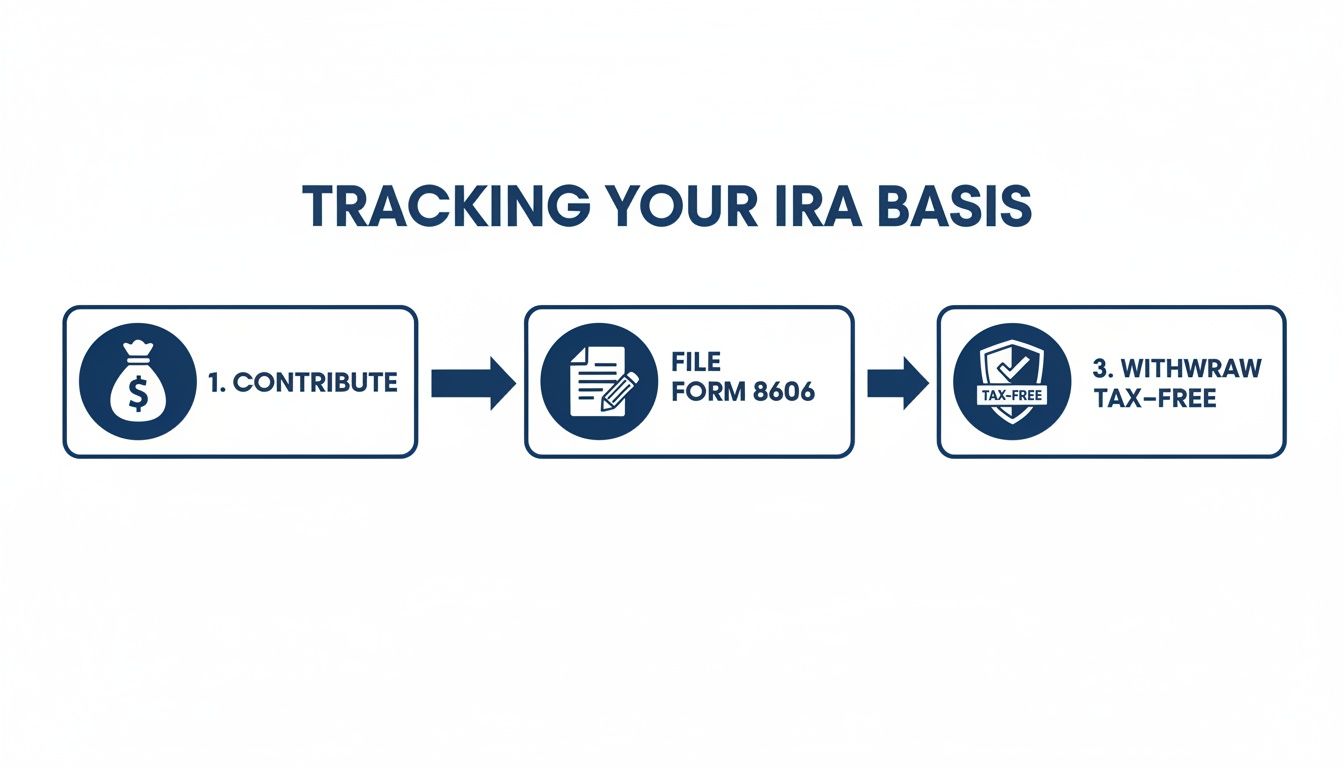
This process—making the after-tax contribution, filing Form 8606 to track it, and then taking a distribution—shows why meticulous documentation is your best friend. It’s the only way to prove to the IRS what part of your withdrawal should be tax-free.
A Practical Example of the Pro-Rata Calculation
Let's walk through a real-world scenario to see how this plays out. Imagine an investor named Alex who wants to do a "Backdoor Roth IRA" conversion.
Here's a snapshot of Alex's IRA situation at the end of the year:
- Total After-Tax Basis: $20,000 (from years of making non-deductible contributions).
- Total Pre-Tax IRA Funds: $80,000 (this includes deductible contributions plus all investment growth).
- Total Value of All IRAs: $100,000.
Alex decides to convert $10,000 to his Roth IRA. A common mistake would be to assume he can just move $10,000 of his after-tax money over. Instead, he has to apply the pro-rata rule.
Here’s the step-by-step math:
-
Calculate the Tax-Free Percentage: First, we figure out what portion of Alex's total IRA balance is made up of after-tax money.
- Formula: (Total After-Tax Basis / Total Value of All IRAs)
- Calculation: ($20,000 / $100,000) = 20%
- This tells us that 20% of any money Alex takes out will be tax-free.
-
Apply the Percentage to the Converted Amount: Now, we apply that percentage to the $10,000 Alex is converting.
- Tax-Free Portion: $10,000 x 20% = $2,000
- Taxable Portion: $10,000 x 80% = $8,000
In this case, even with $20,000 in after-tax funds available, converting just $10,000 still creates $8,000 of taxable income for the year. This is a far cry from the completely tax-free move many people expect. This calculation must be reported accurately on IRS Form 8606, which makes understanding the pro-rata rule absolutely non-negotiable for anyone with after-tax money in an IRA.
Powerful Strategies for Your After-Tax IRA
Knowing the rules is one thing, but turning that knowledge into action is what really builds wealth. Now that you have a solid handle on your IRA basis and the pro-rata rule, we can dive into the powerful strategies that make after-tax contributions so valuable. These aren't just obscure tax loopholes; they are legitimate techniques that can transform a simple non-deductible contribution into a cornerstone of a tax-efficient retirement plan.
The main event here is the Backdoor Roth IRA. This isn’t an official type of account you can open, but rather a well-known, two-step strategy. It's primarily used by high-income earners who are legally prevented from contributing directly to a Roth IRA. Think of it as a financial workaround that lets you fund a Roth account, no matter what your income is.
The Backdoor Roth IRA Explained
At its core, the Backdoor Roth IRA is a simple maneuver. First, you make a non-deductible (after-tax) contribution to a Traditional IRA. Second, once the funds have settled, you convert that Traditional IRA into a Roth IRA. It's that straightforward.
If you don't have any other pre-tax money sitting in any Traditional, SEP, or SIMPLE IRAs, this conversion is completely tax-free. You’ve successfully moved after-tax money into a Roth, where it can now grow and be withdrawn tax-free in retirement—all while neatly sidestepping the Roth IRA income limits.
This strategy is a direct and legal method for high earners to gain access to the significant long-term tax benefits of a Roth IRA. It turns a contribution limit into a strategic opportunity for tax diversification.
The sheer volume of retirement assets shows just how important these strategies are. Between the first and second quarters of 2025, total IRA assets in the U.S. jumped from $16.8 trillion to $18.0 trillion—a 7.0 percent increase. Yet, the average balances reveal a huge generational gap: Baby Boomers hold an average of $257,002, while Gen Z is at just $6,672, highlighting the incredible power of long-term, tax-free growth.
Sidestepping the Pro-Rata Rule
As we've covered, the pro-rata rule is the big roadblock here. It can turn a supposedly tax-free Backdoor Roth IRA into a taxable headache if you also have pre-tax IRA funds. But there’s a clever way to get around this. Many 401(k) plans allow you to roll in funds from an IRA.
If your employer's plan allows it, you can perform a "reverse rollover." This involves moving all your pre-tax IRA money (from Traditional, SEP, and SIMPLE IRAs) into your current 401(k). This move effectively isolates your after-tax basis, leaving it as the only money in your Traditional IRA. Once that's done, you're clear to do a Backdoor Roth IRA conversion completely tax-free. Our guide on rolling over a 401(k) to an IRA while still employed gives more context on how these accounts interact.
The Mega Backdoor Roth IRA
For those lucky enough to have the right kind of 401(k) plan, an even more powerful strategy exists: the Mega Backdoor Roth IRA. This technique lets you funnel significantly more money into a Roth account than the standard contribution limits allow. For this to work, your employer’s 401(k) plan needs to offer two key features:
- After-tax contributions: These are entirely different from Roth 401(k) contributions. They are extra contributions made on top of your normal employee deferrals.
- In-service withdrawals or in-plan conversions: This is the critical part—the ability to move those after-tax contributions out of the 401(k) and into a Roth IRA (or into the plan's Roth 401(k) bucket) while you are still employed.
This strategy opens the door to contributing up to the overall IRS limit for 401(k)s ($69,000 in 2024), minus your own and your employer's contributions. It effectively creates a massive pipeline for getting money into your Roth accounts. To really get the most out of this, understanding the nuances of max Roth conversions can be a game-changer.
Pairing Your IRA with a 72(t) SEPP for Early Retirement
If you’re planning to leave the workforce before age 59½, one of your biggest challenges is creating a reliable income stream without getting hit with early withdrawal penalties. This is where your after-tax IRA basis can become a surprisingly powerful tool, especially when you pair it with a 72(t) Substantially Equal Periodic Payment (SEPP) plan. It's a strategy that can make early retirement a tangible reality instead of just a dream.

A 72(t) SEPP is an IRS-approved method that lets you tap into your IRA or other qualified retirement accounts before the traditional retirement age, sidestepping the usual 10% early withdrawal penalty. When you already have after-tax money—or basis—in your IRA, this strategy becomes even more tax-efficient.
Interestingly, the pro-rata rule, which often complicates things like Roth conversions, actually works in your favor here. Each payment you receive from your 72(t) plan is a calculated mix of your pre-tax and after-tax funds. That means a slice of every single distribution you take is completely tax-free.
See the Tax Advantage in Action
Let’s look at a couple of scenarios to see the real-world cash-flow difference this makes. Imagine two early retirees who each need $50,000 a year from their $1,000,000 IRA to live on.
Scenario A: No After-Tax Basis
- IRA Value: $1,000,000 (all pre-tax)
- Annual 72(t) Payment: $50,000
- Taxable Income: $50,000
- Tax-Free Portion: $0
In this situation, every dollar that comes out of the IRA is fully taxable as ordinary income. Simple, but not very efficient.
Scenario B: With After-Tax Basis
- IRA Value: $1,000,000
- After-Tax Basis: $250,000 (25% of the total)
- Annual 72(t) Payment: $50,000
- Tax-Free Portion: $12,500 (25% of $50,000)
- Taxable Income: $37,500
Just by having that after-tax basis, the second retiree slashes their taxable income by $12,500 every single year of their SEPP plan. Over five years, that's $62,500 received completely tax-free, which can dramatically lower their overall tax burden during those critical early retirement years.
This strategy transforms an after-tax IRA from a simple savings vehicle into an active tool for generating more efficient retirement income. It directly increases your take-home pay when you need it most.
Why This Matters for Early Retirees
For anyone trying to bridge the income gap between their last day of work and age 59½, this approach is a game-changer. Those tax savings can make a huge difference in maintaining your lifestyle without burning through your nest egg faster than you’d like. To get deeper into the mechanics, you can read our complete guide on the rules for Substantially Equal Periodic Payments.
The scale of retirement savings in the U.S. underscores just how important tax-efficient withdrawal strategies are. By the second quarter of 2025, total IRA assets hit a staggering $18.0 trillion, highlighting their role as a cornerstone for savers.
Ultimately, combining a 72(t) SEPP with an after-tax IRA basis is a sophisticated planning technique. It demands careful calculation and strict adherence to IRS rules, but the payoff is a more tax-efficient, sustainable income stream to help you fund your early retirement dreams.
Common Pitfalls to Avoid with After Tax IRAs
Dipping your toes into the world of after-tax IRA contributions can open up some fantastic financial strategies. But, and this is a big but, it also lays out a few tripwires that can be incredibly costly if you’re not paying close attention. Getting the strategy right is one thing; avoiding the simple, common mistakes is what really protects your savings.
The most painful errors almost always come down to a simple paperwork oversight or not quite grasping how all your different IRA accounts are treated as one big pool in the eyes of the IRS. A tiny mistake today can easily snowball into a massive tax headache years down the road.
Forgetting to File Form 8606
This is, hands down, the most common and expensive mistake people make. When you make a non-deductible contribution but don’t file Form 8606, you're basically telling the IRS that the money you put in was pre-tax. You've left them with no official record of your after-tax basis.
Let's say you contribute $6,000 of your after-tax money into a Traditional IRA and simply forget to file the form. Fast forward twenty years. You go to pull that $6,000 back out, along with all the money it's earned. Without that paper trail of filed 8606 forms, the IRS sees the entire withdrawal as taxable income. You'll end up paying taxes on your original contribution for a second time.
Think of Form 8606 as your official tax receipt. It’s not a suggestion—it's the only way to prove to the IRS you already paid tax on that money. Without it, you have no proof.
Misunderstanding the Pro-Rata Aggregation Rule
Another huge pitfall is underestimating the pro-rata rule. A lot of people think they can open a brand new, empty Traditional IRA, fund it with after-tax money, and then convert just that account to a Roth, tax-free. It sounds logical, but it’s a fundamental misunderstanding of how the rules work.
For tax purposes, the IRS lumps all your Traditional, SEP, and SIMPLE IRAs together into one giant account. You can't just pick and choose to convert only the after-tax dollars.
A Classic Pro-Rata Misstep
- The Setup: Sarah has a $90,000 rollover IRA from an old 401(k), which is all pre-tax money. She opens a new Traditional IRA and contributes $10,000 after-tax, with the goal of doing a clean Backdoor Roth conversion.
- The Mistake: Sarah thinks she can convert just that new $10,000 contribution without paying any tax.
- The Reality: The IRS sees her total IRA balance as $100,000. Her after-tax basis is only $10,000, which is 10% of the total. When she converts $10,000, only 10% of it ($1,000) is considered a tax-free return of her contribution. The other $9,000 is treated as a taxable conversion of pre-tax funds.
This aggregation rule is non-negotiable, and it trips up even experienced investors.
Keeping Poor Personal Records
While Form 8606 is your official record with the government, the responsibility for keeping track of it falls squarely on your shoulders. IRS records can get lost, and systems aren't perfect. It's up to you to be able to prove your basis, even if that means digging up a form from decades ago.
A little organization now can save you a world of hurt later.
- Save Every Form: Keep both a digital and a paper copy of every single Form 8606 you file. Store them with your tax returns for that year.
- Track Your Basis: Use a simple spreadsheet to keep a running tally of your total after-tax contributions, distributions, and conversions over the years.
- Hold Onto Statements: Your year-end IRA statements (Form 5498) show your contributions for the year and serve as great backup documentation.
These simple habits build an ironclad paper trail. Steering clear of these common blunders will ensure your after-tax IRA strategy actually builds your wealth instead of creating an unexpected and completely avoidable tax bill.
Common Questions About After-Tax IRA Contributions
When you start digging into the rules for after-tax IRA contributions, a lot of questions tend to pop up. It's totally normal. Let's walk through some of the most frequent ones to clear up the confusion and help you manage your retirement funds with confidence.
How Do I Know if My Traditional IRA Contribution Is Deductible?
Figuring out if you can deduct your Traditional IRA contribution really comes down to two things: your Modified Adjusted Gross Income (MAGI) and whether you (or your spouse) have a retirement plan at work.
Each year, the IRS sets specific income ranges. If you're covered by a workplace plan and your income is above the limit for your filing status, then your contribution is non-deductible. If your income is below the range, you can deduct the full amount. Always check the current year's IRS income thresholds to see where you stand.
Can I Just Withdraw My After-Tax Contributions Without Touching the Earnings?
Unfortunately, no. The IRS doesn't let you pick and choose which dollars to pull out. Any withdrawal you take from any of your Traditional IRAs is automatically hit with the pro-rata rule.
This rule basically says that every dollar coming out of your IRA is a mix of your after-tax money (your basis) and your pre-tax money (contributions and earnings). That's why keeping a meticulous record of your basis on Form 8606 is an absolute must—it's the only way to prove how much of your withdrawal is tax-free.
What Happens if I Forget to File Form 8606 for a Few Years?
This is a common and costly mistake. If you don't file Form 8606, the IRS has no record of your after-tax contributions. They'll just assume all the money in your IRA is pre-tax. When you eventually take a distribution, you'll be taxed on the entire amount, meaning you'll pay taxes on your after-tax money a second time.
You can go back and file amended tax returns to add Form 8606 and fix your basis, but it's a real headache. The best thing you can do is to diligently file the form every single year you make a non-deductible contribution, take a distribution from an IRA with a basis, or do a Roth conversion. A few minutes of paperwork each year can save you from a major financial headache later on.
Planning an early retirement means creating a smart, tax-efficient income stream. Spivak Financial Group specializes in building plans like the 72(t) SEPP to help you access your funds without penalty. Find out how we can help you reach your financial goals by visiting https://72tprofessor.com or calling us at (844) 776-3728.
Spivak Financial Group
8753 E. Bell Road
Suite #101
Scottsdale, AZ 85260
(844) 776-3728
https://72tprofessor.com