
Yes, you can absolutely get your 401(k) money before age 59½ without that dreaded 10% early withdrawal penalty, but you have to know the rules of the game. The IRS has carved out specific exceptions for situations life throws at you.
We're talking about things like qualifying hardship distributions for immediate financial emergencies, becoming disabled, or facing certain major medical expenses. Another popular route is the "Rule of 55," which applies if you leave your job at age 55 or older.
For those who need a predictable income stream to bridge the gap to retirement, a Series of Substantially Equal Periodic Payments (SEPP), also known as a 72(t) plan, is a powerful but complex tool for avoiding the 401k early withdrawal penalty.
The Real Cost of Early 401k Withdrawals

When you're facing a financial crunch, that hefty 401(k) balance can look like a life raft. But before you jump, you need to understand that an early withdrawal isn't just accessing your own money—it's a costly move with consequences that ripple out for years.
The most obvious hit is the 10% early withdrawal penalty the IRS slaps on any funds you take out before age 59½. That's an immediate loss, right off the top.
But it doesn't stop there. The entire withdrawal amount is usually taxed as ordinary income. This can easily bump you into a higher tax bracket for the year, meaning you hand over even more of your hard-earned savings to Uncle Sam.
This one-two punch of penalties and taxes means the cash you actually pocket is way less than what you took out. And more people are feeling this pain. Recent Vanguard data reveals 4.8% of 401(k) holders took hardship distributions, with another 4.5% making non-hardship withdrawals. The trend is clearly heading up.
A Real-World Example of the Financial Impact
Let's put some real numbers to this. Imagine you're 45, in the 22% federal tax bracket, and need $20,000 for a new roof.
- Initial Withdrawal Amount: $20,000
- Immediate 10% IRS Penalty: –$2,000
- Estimated Federal Income Tax (22%): –$4,400
- Potential State Income Tax (let's say 5%): –$1,000
After all is said and done, your $20,000 withdrawal has shrunk to just $12,600 in your hands. You've effectively lost $7,400, or 37% of your money, to taxes and penalties.
But the true cost is even greater. That $20,000 is no longer invested and growing for your retirement. Assuming a 7% average annual return, that single withdrawal could cost you nearly $80,000 in future retirement funds over the next 20 years.
Your Roadmap to Penalty-Free Access
Thankfully, there are smarter ways to access your money. Understanding the IRS rules for avoiding the 401(k) early withdrawal penalty is the first critical step. While the details can get tricky, the strategies fall into a few key buckets. For a deeper dive, our video explains how to get your retirement money without penalty.
To help you get started, here’s a quick snapshot of the primary strategies we'll be breaking down in this guide.
Quick Guide to Avoiding the 10% Early Withdrawal Penalty
| Strategy | Best For | Key Consideration |
|---|---|---|
| IRS Exceptions | Those with qualifying medical expenses, disability, or a court order (QDRO). | Requires specific and often extensive documentation to prove eligibility. |
| Rule of 55 | Individuals separating from their employer in the year they turn 55 or later. | Only applies to the 401(k) of your most recent employer; does not apply to IRAs. |
| 72(t) SEPP | Individuals needing a predictable, long-term income stream before retirement age. | Requires a strict commitment to a payment schedule for at least five years or until age 59½. |
| 401(k) Loan | Those who need temporary cash and have a stable job to ensure repayment. | Failure to repay the loan on time can result in it being treated as a taxable distribution. |
Think of this table as your starting point. Each option has unique requirements and potential pitfalls, which we’ll explore in detail to help you find the right path for your situation.
Navigating IRS Hardship and Other Exceptions
While that 10% penalty is a powerful deterrent, the IRS knows that life happens. Severe, unforeseen circumstances can sometimes force you to tap into your retirement savings early. Because of this, they’ve carved out specific exceptions that let you access your 401(k) funds without getting hit with that extra tax.
It's critical to remember, though, that you'll almost always still owe regular income tax on the withdrawal. These aren't loopholes; they're narrow provisions for genuine emergencies. Think of them as safety valves. Getting your withdrawal to qualify requires meeting strict criteria and, frankly, a decent amount of paperwork to prove your case to your plan administrator.
What Counts as a Hardship Distribution?
One of the most talked-about penalty exceptions is the hardship distribution. But here’s the first hurdle: your 401(k) plan isn't required to offer them. Your first step is to confirm if this is even on the table. If it is, you have to prove you have an "immediate and heavy financial need" that you can't reasonably cover with other money.
The IRS gives a "safe harbor" list of events that automatically meet the "need" test:
- Medical Expenses: Costs for medical care for you, your spouse, dependents, or a primary beneficiary.
- Buying a Home: Funds needed for the purchase of your main home (this doesn't cover mortgage payments).
- Education Costs: Tuition and related fees for the next 12 months of post-secondary education for you, your spouse, kids, or dependents.
- Preventing Eviction or Foreclosure: The specific amount needed to stop you from losing your primary residence.
- Funeral Expenses: Covering the costs for a parent, spouse, child, or dependent.
- Home Repairs: Certain costs to repair damage to your principal residence.
Even if your situation fits one of those buckets, you're not done. You also have to show that the withdrawal is your only option. This usually means certifying that you’ve already tried to get the money elsewhere, like selling assets or taking out a regular loan.
Other Key IRS Exceptions to Know
Hardships are just one piece of the puzzle. The IRS has several other important situations where the 10% penalty is waived, each with its own set of rules.
A major one is for distributions made because of a total and permanent disability. If a medical professional can document that you're unable to work due to a physical or mental impairment that's expected to be long-term or fatal, you can access your 401(k) penalty-free.
Here’s a snapshot from the IRS website that gives you a quick look at some of the other common penalty exceptions.
As you can see, the list is very specific. It covers life events like becoming disabled, having certain high medical bills, or receiving a court order.
Speaking of medical bills, another important exception is for unreimbursed medical expenses. You can take a penalty-free withdrawal for medical costs that are more than 7.5% of your adjusted gross income (AGI) for the year. You don't even have to itemize your deductions to use this exception.
And for those going through a divorce, funds distributed under a Qualified Domestic Relations Order (QDRO) are not subject to the 10% penalty for the person receiving the funds (the alternate payee).
Recent Law Changes You Should Know About
Congress has recognized that people sometimes need more flexibility. The SECURE 2.0 Act brought in a few new, limited exceptions to the early withdrawal penalty. One of the most notable allows for penalty-free annual withdrawals of up to $1,000 for personal emergency expenses.
But—and this is a big but—that $1,000 is still subject to ordinary income tax, and you can only do it once per calendar year. You can dig deeper into how these new early withdrawal tax rules work on Kiplinger.com.
Expert Takeaway: Navigating IRS exceptions is all about precision. You have to get it right. Before you do anything, check your 401(k) plan's specific rules and get all your documentation in order. One wrong move could trigger the very penalty you’re working so hard to avoid.
Tapping Into Your 401(k) Early With the Rule of 55

For anyone dreaming of an early retirement, that stretch between age 55 and 59½ often feels like a financial waiting game. The good news? The IRS created a special provision just for this scenario: the Rule of 55.
This rule is one of the most straightforward ways to get around the dreaded 10% penalty on early 401(k) withdrawals. In a nutshell, if you leave your job—whether you quit, get laid off, or retire—in or after the calendar year you turn 55, you can start taking money from that specific 401(k) without getting hit with the penalty. It's a fantastic tool for bridging the income gap until your other retirement funds become accessible.
But this isn't a free-for-all. The rule has some very strict, non-negotiable requirements. Getting the details wrong can be a surprisingly expensive mistake.
How the Rule of 55 Actually Works
Here’s the single most important detail people miss: the Rule of 55 only applies to the 401(k) from the job you just left. It has absolutely no bearing on 401(k)s from old jobs or any of your IRAs. This is where many people trip up.
Let's walk through a quick example.
Imagine Sarah is 56 and ready to retire. She has two retirement accounts:
- A $500,000 401(k) with her current company.
- A $200,000 401(k) from a job she left five years ago.
When Sarah leaves her current job, she can immediately start taking penalty-free withdrawals from that $500,000 account. But if she touches the $200,000 from her old employer's plan, those withdrawals will be subject to the 10% penalty. Why? Because she didn't leave that job in the year she turned 55 or later.
One of the biggest blunders you can make is immediately rolling your current 401(k) into an IRA after leaving your job. The second those funds hit the IRA, the Rule of 55 is off the table. To make this work, you must leave the money in your former employer’s 401(k) and take the distributions directly from that plan.
Key Things to Know Before You Jump In
While the Rule of 55 lets you sidestep the penalty, it doesn't get you out of paying taxes. Every dollar you withdraw is still treated as ordinary income, just like a regular 401(k) distribution. Your plan administrator is also required to withhold 20% for federal taxes right off the top.
Before you pull the trigger, make sure you've checked these boxes:
- Does Your Plan Allow It? The IRS permits this, but your employer’s 401(k) plan doesn’t have to offer it. You need to read your plan documents or call the administrator to confirm that they support Rule of 55 distributions.
- Special Provision for Public Safety Workers: There's a bit more flexibility for qualified public safety workers, like police officers, firefighters, and air traffic controllers. For them, the age requirement drops from 55 to 50.
- The Income Tax Hit: Remember, these withdrawals are taxable income. Taking out a large chunk could easily bump you into a higher tax bracket for the year. It pays to be strategic about how much you withdraw and when.
The Rule of 55 can be an incredibly effective strategy for funding the first few years of an early retirement. As long as you understand its very narrow scope—that it only applies to the 401(k) of the employer you just separated from—you can use it to your advantage and get a head start on your post-career life.
Creating an Income Stream with a 72(t) SEPP
If you find yourself needing a reliable, predictable income stream before hitting age 59½, one of the most powerful tools in your arsenal is a Series of Substantially Equal Periodic Payments (SEPP). This strategy, which falls under IRS Code Section 72(t), is your ticket to avoiding that painful 401(k) early withdrawal penalty. But let's be clear: this isn't for a one-off withdrawal. It’s a disciplined plan for turning your retirement funds into a steady paycheck.
Think of a SEPP as creating your own private pension. You get to tap into your retirement savings early and penalty-free, but it comes with a serious commitment. Once you begin, you’re locked into the payment schedule for at least five full years or until you turn 59½—whichever period is longer. That rigidity means this is a decision that demands careful thought and a rock-solid understanding of your financial needs for the long haul.
How a SEPP Provides Penalty-Free Income
A SEPP works by calculating a very specific annual withdrawal amount from your retirement account, an amount you must take each year without any changes. The IRS gives you three different ways to run the numbers, and each one results in a different payment. This bit of flexibility is key, as it lets you pick a calculation that feels right for your income goals and the size of your nest egg.
Choosing the right method is absolutely critical because it directly dictates your annual cash flow. Get the calculation wrong or make a mistake executing the plan, and the consequences are severe. The IRS can retroactively slap the 10% penalty on every single distribution you’ve taken.
Here’s a quick rundown of the three IRS-approved calculation methods:
- The Amortization Method: This approach calculates a fixed annual payment by spreading your account balance over your single or joint life expectancy. It generally gives you the highest and most consistent payment of the three options.
- The Annuitization Method: This method uses an annuity factor provided by the IRS to figure out a fixed annual payment. It’s based on your account balance, your age, and a reasonable interest rate. Like the amortization method, this payment amount stays the same for the life of the plan.
- The Required Minimum Distribution (RMD) Method: This one is the oddball. Unlike the other two, the RMD method results in a payment amount that gets recalculated every single year based on your prior year-end account balance. Your income will go up and down with the market, which could be a good or bad thing depending on how you feel about risk.
Understanding the SEPP Commitment
I can't overstate the commitment required for a 72(t) plan. Let's imagine you start a SEPP at age 52. You are on the hook for taking those exact calculated payments until you're at least 59½. Now, if you start at age 56, the five-year rule kicks in, meaning you have to stick with it until you're 61.
Any deviation from the plan—taking too much, taking too little, or stopping payments early—"busts" the whole thing. If that happens, the IRS will come back and apply the 10% penalty to every dollar you've withdrawn since day one, plus interest. This is precisely why getting professional guidance when setting up a SEPP is so essential.
For those who want to get into the nitty-gritty, you can learn more about how a 72t works on our detailed guide. It takes a much deeper dive into the specific rules and requirements.
Is a 72(t) SEPP Right for You?
A SEPP can be a fantastic tool, but it's not a one-size-fits-all solution. It's really designed for early retirees who need to bridge an income gap until they reach 59½ or for folks with a long-term financial need that demands a steady, predictable source of funds.
The screenshot below from our homepage at 72tProfessor.com really gets to the heart of what this strategy can do for you.
As the image highlights, a well-structured SEPP can unlock "life-changing, consistent income" without those punishing IRS penalties. It can be the key that lets you chase your goals, whether that’s traveling the world, caring for a loved one, or simply enjoying the early retirement you've worked so hard for.
It’s an ideal fit for someone who has done their homework and is confident they won't need to mess with their withdrawal amount for the entire duration. But if your income needs are all over the place or you think you might need a large lump sum down the road, you should probably look at other options like a 401(k) loan or another penalty exception. The trick is to match the strategy to your real-life circumstances.
Weighing Your Options: 401(k) Loans vs. Hardship Withdrawals
When you’re in a financial bind, that growing 401(k) balance can look like a tempting source of quick cash. Two of the most common ways people tap into these funds are through a 401(k) loan or a hardship withdrawal. While both get you money, they are worlds apart in how they work and the long-term impact they’ll have on your retirement.
Making the wrong move in a moment of panic can be incredibly costly. Think of a 401(k) loan as borrowing from your future self—it comes with a structured repayment plan. A hardship withdrawal, however, is a permanent move. The money is gone for good, often triggering a nasty combination of taxes and penalties that shrink your nest egg forever. Let's break down how each one works so you can avoid that dreaded 401(k) early withdrawal penalty.
The Case for a 401(k) Loan
On the surface, a 401(k) loan often seems like the smarter play, and for a few good reasons. You're essentially borrowing your own money, and the interest you pay goes right back into your own account, not to a bank. It can feel like a win-win.
Best of all, taking a loan doesn't trigger any immediate taxes or penalties. As long as you stick to the repayment rules, the IRS doesn’t even see it as a distribution. Most plans will let you borrow up to 50% of your vested balance (with a $50,000 cap) and give you five years to pay it back, usually through automatic deductions from your paycheck.
But here’s the biggest catch: your job. If you leave your company for any reason—voluntarily or not—the entire outstanding loan balance can become due almost immediately. If you can't pay it back in full within the grace period (which the Tax Cuts and Jobs Act did extend), the whole amount is reclassified as a taxable distribution. That means you’ll owe income tax on the balance and get hit with the 10% early withdrawal penalty.
This decision tree shows how a long-term commitment like a SEPP requires careful planning, much like any choice to access retirement funds early.
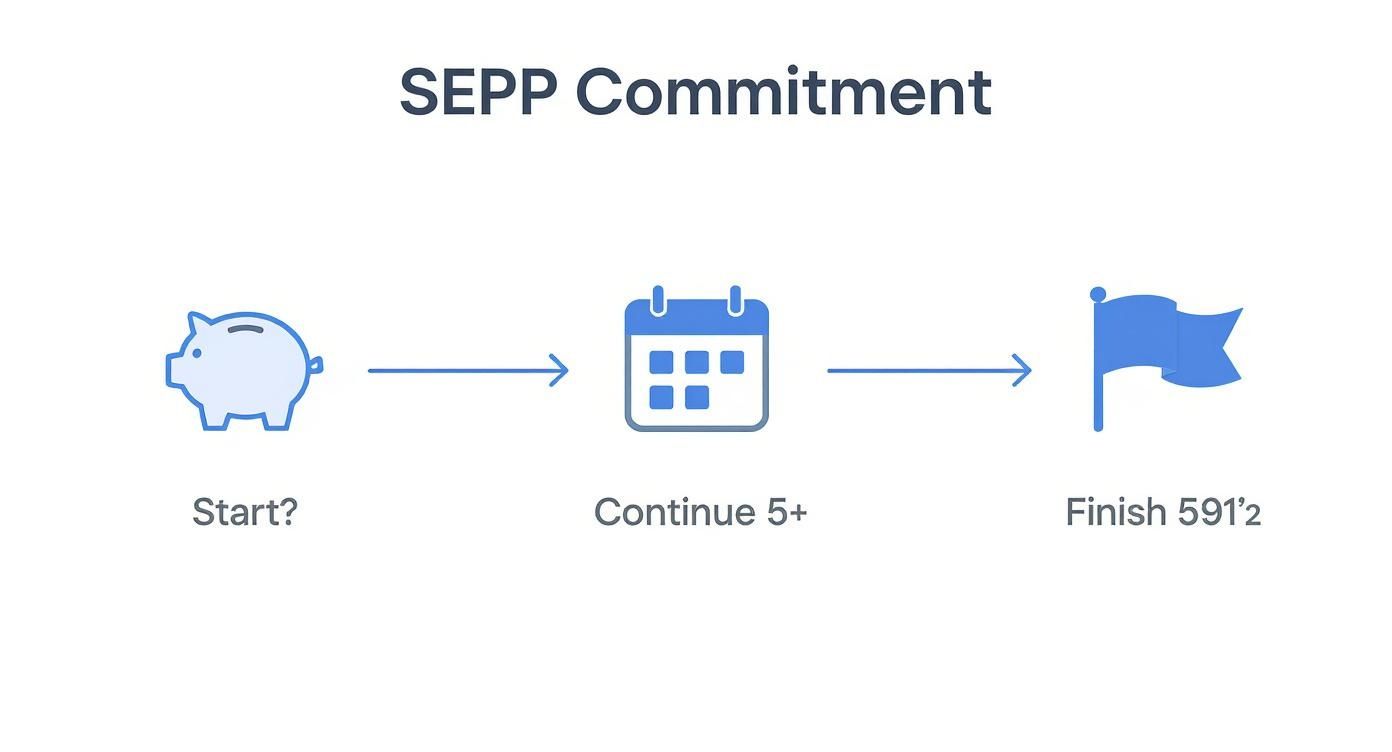
This visualization highlights the critical checkpoints of a long-term financial commitment, reinforcing the need to ensure you can stay the course before starting.
Understanding the Reality of Hardship Withdrawals
A hardship withdrawal should always be your absolute last resort. Unlike a loan, you don't pay this money back. It's gone forever, along with all the future growth it would have generated. To even qualify, you have to prove to your plan administrator that you have an "immediate and heavy financial need" and have already exhausted every other reasonable source of cash.
The IRS is very specific about what counts. Qualifying circumstances are narrow and include things like:
- Certain medical expenses
- Costs to purchase your main home
- Tuition and related educational fees
- Payments needed to prevent eviction or foreclosure
The brutal truth is that most hardship withdrawals are still subject to both ordinary income tax and the 10% early withdrawal penalty. You lose a huge chunk of your own money right off the bat. While rare exceptions have been made, like during the pandemic with the CARES Act, you should never count on that kind of relief being available. For more insight, you can learn how legislation can impact withdrawal penalties on psca.org.
Key Takeaway: A hardship withdrawal is a permanent, taxable event that shrinks your retirement savings. A loan preserves your savings but comes with the significant risk of default if you leave your job.
Head-to-Head Comparison
Choosing between a loan and a hardship withdrawal means taking a hard, honest look at your current situation and job stability. If you're considering other ways to create an income stream, you might want to read our guide on borrowing from your 401(k) versus using a 72(t) SEPP, as a SEPP offers another powerful, albeit complex, alternative.
To make things crystal clear, let's put these two options side-by-side.
401(k) Loan vs. Hardship Withdrawal vs. SEPP
| Feature | 401(k) Loan | Hardship Withdrawal | 72(t) / SEPP |
|---|---|---|---|
| Repayment | Required. Paid back with interest to your own account, usually over 5 years. | Not allowed. This is a permanent distribution. | Not allowed. This is a series of permanent distributions. |
| Taxes & Penalties | None, if repaid on time. Becomes taxable and penalized if you default. | Taxable as income. The 10% penalty almost always applies. | Taxable as income, but the 10% penalty is waived. |
| Impact on Savings | Neutral, if repaid. Your account balance is restored over time. | Permanent loss. Reduces your retirement nest egg forever. | Permanent loss. Strategically depletes your account balance over time. |
| Job Loss Risk | High. Loan may become due immediately, risking default. | None. The withdrawal is a completed transaction. | None. The payment schedule is independent of your job. |
| Best For | Short-term cash needs for those with very high job security. | Dire, qualifying emergencies when no other funds are available. | Creating a penalty-free income stream for early retirement needs. |
Ultimately, a loan is a temporary bridge that works best if your job is secure. A hardship withdrawal is a permanent and expensive solution meant only for true emergencies. Each path has serious consequences, so weighing them carefully is one of the most important financial decisions you can make.
Burning Questions About 401(k) Early Withdrawals
Even after mapping out all the strategies to sidestep the 401(k) early withdrawal penalty, a few key questions always seem to pop up. Financial rules are notoriously complex, and it’s completely normal to want to nail down the details that affect your specific situation.
Let's dive into some of the most common concerns we hear from people every day. We'll give you straight, clear answers to clear up any confusion and help you move forward with confidence.
If I Qualify for a Penalty-Free Withdrawal, Do I Still Owe Taxes?
Yes, absolutely. This is one of the most critical and often misunderstood aspects of early withdrawals.
"Penalty-free" does not mean "tax-free." Any money you pull from a pre-tax retirement account, like a traditional 401(k), is considered ordinary income for the year you take it.
That means the withdrawal gets tacked onto your other income, which can easily bump you into a higher tax bracket. To ensure the IRS gets its cut right away, your plan administrator is usually required to withhold a mandatory 20% for federal taxes. Keep in mind, depending on your total income for the year, you might still owe more when it’s time to file your tax return.
Can I Use the Rule of 55 for My IRA?
No—and this is a very common and costly mistake. The Rule of 55 is a special provision that only applies to 401(k) and 403(b) plans. It has zero connection to Individual Retirement Accounts (IRAs), whether they’re Traditional, Roth, SEP, or SIMPLE IRAs.
Here's the trap people fall into: if you leave your job at age 55 and immediately roll your 401(k) into an IRA, you've permanently forfeited your ability to use this rule.
To use the Rule of 55, you must leave the money in the 401(k) of the company you just left. The penalty-free withdrawals have to come directly from that specific plan.
What Happens If I Stop My 72(t) SEPP Payments Early?
Stopping or changing your Series of Substantially Equal Periodic Payments (SEPP) before the required term is up has some pretty severe financial consequences. The IRS rules for 72(t) plans are incredibly strict, and breaking them triggers what's known as a "recapture" tax.
This means the 10% early withdrawal penalty gets retroactively applied to every single distribution you've taken since the plan started, plus interest. In short, any benefit you got from the SEPP is completely erased, and you're hit with a major tax bill. That's why you should only start a SEPP if you are absolutely certain you can stick with it for the entire required period—either five years or until you hit age 59½, whichever is longer.
How Do I Prove I Need a Hardship Withdrawal?
You can't just tell your plan administrator you need the money; you have to prove it. You'll need to provide solid evidence that you have an "immediate and heavy financial need" according to the IRS's narrow definitions.
Typically, this means supplying clear documentation that backs up your claim. For example:
- Medical bills or estimates for necessary procedures.
- A purchase agreement for buying your main home.
- An eviction notice or foreclosure documents.
- Tuition statements and invoices from a college or university.
On top of proving the need, you also have to certify that you have no other financial resources available. This means you can't get a commercial loan or sell other assets to cover the cost. If your plan offers 401(k) loans, you are almost always required to take one of those first before you can even be considered for a hardship withdrawal.
Figuring out the complexities of early retirement distributions can feel overwhelming, but you don't have to go it alone. The team at Spivak Financial Group specializes in creating strategies like the 72(t) SEPP to help you access your funds penalty-free. To see how we can build a plan tailored to your life goals, visit us at our Scottsdale office or online.
Spivak Financial Group
8753 E. Bell Road
Suite #101
Scottsdale, AZ 85260
(844) 776-3728
https://72tprofessor.com