
At first glance, placing an annuity in an IRA might sound a little redundant—kind of like wearing a raincoat inside. After all, both IRAs and annuities already offer tax-deferred growth. So, what's the point?
The real value isn’t about doubling down on tax advantages. It’s about something much more fundamental: turning the retirement savings you’ve built up into a contractual guarantee for predictable, lifelong income.
What an Annuity in an IRA Really Means for Your Retirement

Think of your Individual Retirement Account (IRA) as the vault where you’ve diligently stored your nest egg over the years. This vault does a great job of protecting your savings from taxes on growth, letting your investments compound more efficiently.
But the vault itself doesn't shield the value of those investments from the ups and downs of the market. This is where an annuity comes into play.
By purchasing an annuity within your IRA, you’re essentially installing a specialized mechanism inside that vault. This mechanism is a powerful contract with an insurance company, and it’s built to do one thing exceptionally well: turn your pile of assets into a steady, reliable stream of payments you can count on.
The Power of Contractual Guarantees
The main reason to put an annuity in an IRA is to lock in guarantees that other investments, like stocks and mutual funds, simply can't provide. It’s a strategic move to de-risk a portion of your retirement portfolio and inject some much-needed certainty into your financial plan.
Let's take a quick look at the core benefits this strategy brings to the table.
Primary Benefits of an Annuity Inside an IRA
| Feature | Description | Primary Benefit for an IRA Holder |
|---|---|---|
| Guaranteed Lifetime Income | The annuity contract provides a pension-like income stream that you cannot outlive. | Addresses the number one retirement fear: running out of money. |
| Principal Protection | Many modern annuity designs protect your initial investment from market downturns. | Safeguards a portion of your nest egg from stock market volatility. |
| Predictable Returns | Certain types of annuities (like fixed annuities) offer a stable, foreseeable growth rate. | Adds a layer of stability and predictability to your overall portfolio performance. |
At the end of the day, this strategy is about taking a portion of your market-dependent IRA assets and turning it into your own personal pension plan. If you want to dive deeper into this idea, you can learn more about the process of "pensionizing" your portfolio.
Understanding the Key Players
Making this strategy work involves a partnership between three key parties. First, there's you, the IRA owner, who makes the decisions about how to allocate your hard-earned funds.
Second is the insurance company. This is the financial institution that issues the annuity contract and backs the guarantees with its financial strength.
Finally, a knowledgeable financial advisor, like the team here at Spivak Financial Group, plays a critical role. An expert can help you sort through the complexities, find the right product for your specific goals, and make sure the entire strategy fits perfectly with your retirement vision. This teamwork is what makes securing your financial future possible.
How Annuities and IRAs Work Together

To really get how an annuity in an IRA works, it helps to think of your IRA as a special kind of investment bucket. This bucket has its own set of IRS rules, but inside, you have the freedom to fill it with different kinds of investments.
You can take the money already inside your IRA bucket and use it to buy an annuity contract from an insurance company. Doing this doesn't change a thing about your IRA's tax status; it just means you're dedicating a piece of your IRA funds to a tool specifically built to generate income down the road.
The process is often pretty simple, especially if you're moving money from an old 401(k). For those still working, you can get the full rundown by learning more about a 401(k) rollover to an IRA while still employed.
Once that annuity is purchased and sitting inside your IRA, its life unfolds in two main stages.
The Accumulation Phase
First up is what we call the accumulation phase. During this time, the money you’ve put into the annuity can grow, and just like everything else in your IRA, that growth is tax-deferred. No tax bill each year.
How that money grows depends entirely on the type of annuity you've picked out:
- Fixed Annuities: These are straightforward. They work a lot like a Certificate of Deposit (CD), giving you a guaranteed interest rate for a set period.
- Fixed-Indexed Annuities: With these, your potential returns are tied to a market index, like the S&P 500. The cool part? Your original investment is protected from any market downturns.
- Registered Index-Linked Annuities (RILAs): These give you a shot at higher growth linked to an index, but they come with a "buffer" or "floor" to limit your losses if the market drops.
The whole point of this phase is to build up the value of your annuity before you actually need to start spending it. You're letting your money compound without the drag of taxes, getting it ready for the next step.
The Payout Phase
The second stage is the payout phase, sometimes called the annuitization or distribution phase. This is when the annuity starts doing its main job: turning your nest egg into a steady stream of income.
You essentially flip a switch, and the regular payments begin. It's this structured income that really makes the annuity in an IRA strategy stand out.
By converting a lump sum into a series of guaranteed payments, you create a personal pension. This shift from asset accumulation to income distribution is a critical step in securing a predictable and worry-free retirement.
These payouts can be set up to last for a specific number of years or—and this is the big one for many people—for the rest of your life. That lifetime income guarantee is a powerful defense against the very real fear of outliving your savings.
Better yet, for retirees who have to take Required Minimum Distributions (RMDs), these annuity payments can be designed to automatically cover your yearly RMD obligation. It's a clean, mechanical way to turn your savings into reliable paychecks while simplifying your financial life.
Choosing the Right Type of Annuity for Your IRA
Picking an annuity for your IRA isn't a one-size-fits-all deal. Think of it more like choosing the right tool for a very specific job. Each type of annuity strikes a different balance between safety, growth potential, and good old-fashioned predictability. Getting a handle on these differences is the key to matching the product with your actual retirement goals.
The right choice comes down to what you're trying to accomplish. Are you looking for the ultimate in safety and a guaranteed return? Or are you okay with a bit more complexity for a shot at higher growth? Let's break down the most common options you'll find for an IRA.
Fixed Annuities: Predictable and Secure
A Fixed Annuity is the most straightforward option out there, working a lot like a Certificate of Deposit (CD) from a bank. You move a lump sum from your IRA into the annuity, and in return, the insurance company gives you a guaranteed, fixed interest rate for a set period, usually between three and ten years.
This is the go-to for conservative investors who put principal protection and predictability above everything else. If your main objective is to wall off a portion of your IRA from market swings while earning a modest, guaranteed return, a fixed annuity is a powerful tool. It gives your retirement plan a rock-solid foundation.
Fixed-Indexed Annuities: Growth Potential with a Safety Net
For anyone who wants a chance to capture some market gains without actually risking their principal, a Fixed-Indexed Annuity (FIA) offers a really compelling middle ground. An FIA’s performance is linked to a market index, like the S&P 500, but—and this is the important part—your money is never directly invested in the market.
This unique setup gives you two major benefits:
- Upside Potential: When the index it's linked to does well, you get credited interest up to a certain limit. This is often defined by a "cap" or a "participation rate."
- Downside Protection: If the index takes a nosedive, your principal and any interest you've already earned are protected. You simply earn 0% for that period. You never lose money because of a market crash.
FIAs are a hugely popular choice for an annuity in an IRA. They offer a blend of safety and growth that really clicks with retirees who want to do better than fixed rates but just can't stomach the risk of the stock market.
Registered Index-Linked Annuities: Higher Growth with a Buffer
A Registered Index-Linked Annuity (RILA) is a newer kid on the block that offers a higher potential for growth than an FIA, but it comes with a defined level of risk. Just like an FIA, its returns are tied to a market index.
The real difference is in how it handles the bad years. Instead of 100% principal protection, a RILA gives you a "buffer" or a "floor." For example, a buffer might absorb the first 10% of any market loss. If the market drops 15%, your account would only go down by 5%. This structure allows for much higher growth caps in exchange for taking on a measured, known amount of risk.
Recent trends show a huge shift in what investors are looking for. Annuities that offer principal protection or a buffer against downside risk now make up roughly 80% of all annuity sales. In contrast, traditional variable annuities have dropped to about 14%. This points to a clear demand for more certainty in retirement planning. You can see more insights in the 2024 Annuity Insights Report.
This shift makes it clear that today’s retirees are increasingly using an annuity in an IRA to build a secure financial floor for themselves. To see how these accounts fit into the bigger picture, take a look at our guide explaining the differences between a 401(k), IRA, and Roth IRA. For many people, the goal isn't just about accumulating assets anymore; it's about intelligently turning those assets into a reliable income stream that will last.
Weighing the Pros and Cons of an Annuity in an IRA
Every financial tool has its own set of advantages and potential drawbacks, and an annuity in an IRA is no different. Figuring out if this strategy fits into your retirement plan means taking a clear-eyed look at both sides of the coin. This isn't just about the numbers; it's about matching the right tool to your personal goals and how much risk you're comfortable with.
Making this choice is a big deal. At the end of the second quarter, U.S. Individual Retirement Accounts held a staggering $18.0 trillion in assets, with a huge chunk of that money sitting in mutual funds. At the same time, annuity sales hit a record $223.0 billion in the first half of the year, which tells us a lot of people are looking to move some of those assets toward something more predictable. You can read more about these retirement asset trends and what they mean for investors.
Let's dive into a balanced comparison to help you figure out if this strategy makes sense for you.
The Clear Advantages of This Strategy
The main reason to even think about putting an annuity inside your IRA boils down to one powerful word: certainty. In a world full of market swings and economic unknowns, the contractual guarantees an annuity offers can bring a whole lot of peace of mind.
The biggest advantages include:
- Guaranteed Lifetime Income: This is the headline benefit. An annuity can turn a piece of your IRA into a pension-like paycheck you can never outlive. It directly tackles the very real fear of running out of money in your later years.
- Principal Protection: Certain types of annuities, like fixed and fixed-indexed products, protect your initial investment from market losses. If the market takes a nosedive, your principal stays intact, giving your portfolio a stable foundation.
- Simplified RMDs: For retirees who have to take Required Minimum Distributions (RMDs), an annuity can make life a lot easier. The scheduled payments can be set up to automatically cover your yearly RMD, taking one more thing off your financial to-do list.
For many folks heading into retirement, these benefits create a solid financial floor. They ensure the essential bills are paid no matter what the stock market is doing, which often gives them the confidence to invest the rest of their portfolio more aggressively.
Potential Downsides to Consider
While the upsides are pretty compelling, it’s just as important to understand the trade-offs. The guarantees that make annuities so attractive come with certain costs and limitations that might not be a good fit for every investor.
The most common concerns are:
- Fees and Costs: Annuities aren't free. They come with costs that can include administrative fees, mortality and expense charges, and extra fees for optional riders (like an enhanced death benefit). These expenses will eat into your overall returns, so you have to weigh them against the value of the guarantees you’re getting.
- Limited Liquidity and Surrender Charges: Annuities are long-term commitments, not checking accounts. If you need to pull out more than the allowed amount (often 10% a year) during the surrender period, you’ll get hit with a surrender charge. This penalty usually starts high and slowly decreases over several years, making annuities a bad place for your emergency fund.
- Complexity of Contracts: Annuity contracts can be dense, complicated documents. Trying to understand all the terms, conditions, and limitations—like participation rates, caps, and rider provisions—can feel overwhelming. It often takes the help of a financial professional to make sure you know exactly what you’re signing up for.
The decision to use an annuity in an IRA hinges on a simple trade-off: Are you willing to accept certain costs and limitations in exchange for powerful guarantees like lifetime income and principal protection?
Annuities are a hot topic, and it's easy to get caught up in either the hype or the criticism. To cut through the noise, let's lay out the key points side-by-side.
Weighing the Decision: An Annuity in an IRA
| Advantages (Pros) | Disadvantages (Cons) |
|---|---|
| Guaranteed Income for Life: Creates a reliable, pension-like income stream you can't outlive. | Fees and Expenses: Come with various charges (M&E, administrative, rider fees) that can reduce overall returns. |
| Principal Protection: Fixed and fixed-indexed annuities protect your initial investment from market downturns. | Limited Liquidity: Surrender charges (often for 5-10 years) penalize large withdrawals, making them unsuitable for funds you might need unexpectedly. |
| Simplified RMDs: Annuity payments can be structured to automatically satisfy your annual RMDs. | Complexity: The contracts can be difficult to understand without professional guidance, filled with jargon about caps, spreads, and participation rates. |
| Market-Linked Growth Potential (with FIAs/VAs): Offers the opportunity for growth based on market performance, often with downside protection. | Growth Caps: Indexed and variable annuities may limit your upside potential with caps or participation rates, meaning you won't capture all of the market's gains. |
Ultimately, there’s no single right answer for everyone. It all comes down to your individual needs, your timeline, and frankly, what helps you sleep best at night. By carefully weighing these pros and cons, you can make an informed choice that truly supports your long-term retirement security.
Funding Early Retirement with an IRA Annuity and 72(t) SEPP
Dreaming of retiring early but worried about that IRS penalty for touching your funds before age 59½? It’s a common roadblock. That standard 10% early withdrawal penalty feels designed to keep your money locked up until you're much older.
But what if I told you there’s a powerful, IRS-approved strategy to access your IRA funds early, completely penalty-free? It’s called Rule 72(t), and it allows for something known as Substantially Equal Periodic Payments (SEPP). This is where combining an annuity in an IRA can be an absolute game-changer for anyone looking to punch the clock for the last time.
The idea behind a SEPP is pretty simple: if you commit to taking a series of calculated, equal payments from your IRA for a specific time, the IRS agrees to waive the 10% penalty. An immediate annuity is practically tailor-made for this, since its entire job is to provide a guaranteed, predictable stream of income.
How an Annuity Powers a 72(t) Plan
Here's the catch: the rules for a 72(t) SEPP plan are incredibly rigid. You have to calculate your payments using one of three specific IRS-approved methods. Once you start, you cannot change that payment schedule for any reason. One tiny mistake could cause the 10% penalty to be slapped back on all your previous withdrawals, plus interest. It’s a high-stakes game.
This is exactly where an immediate annuity becomes your best friend. You can use a portion of your IRA to buy an annuity contract built to pay out the precise dollar amount your SEPP calculation demands. The insurance company's contractual guarantee takes over, virtually eliminating the risk of human error.
This chart breaks down the core trade-off. An annuity delivers the guaranteed income and protection you need for a SEPP, but you have to be comfortable with its fees and structure.
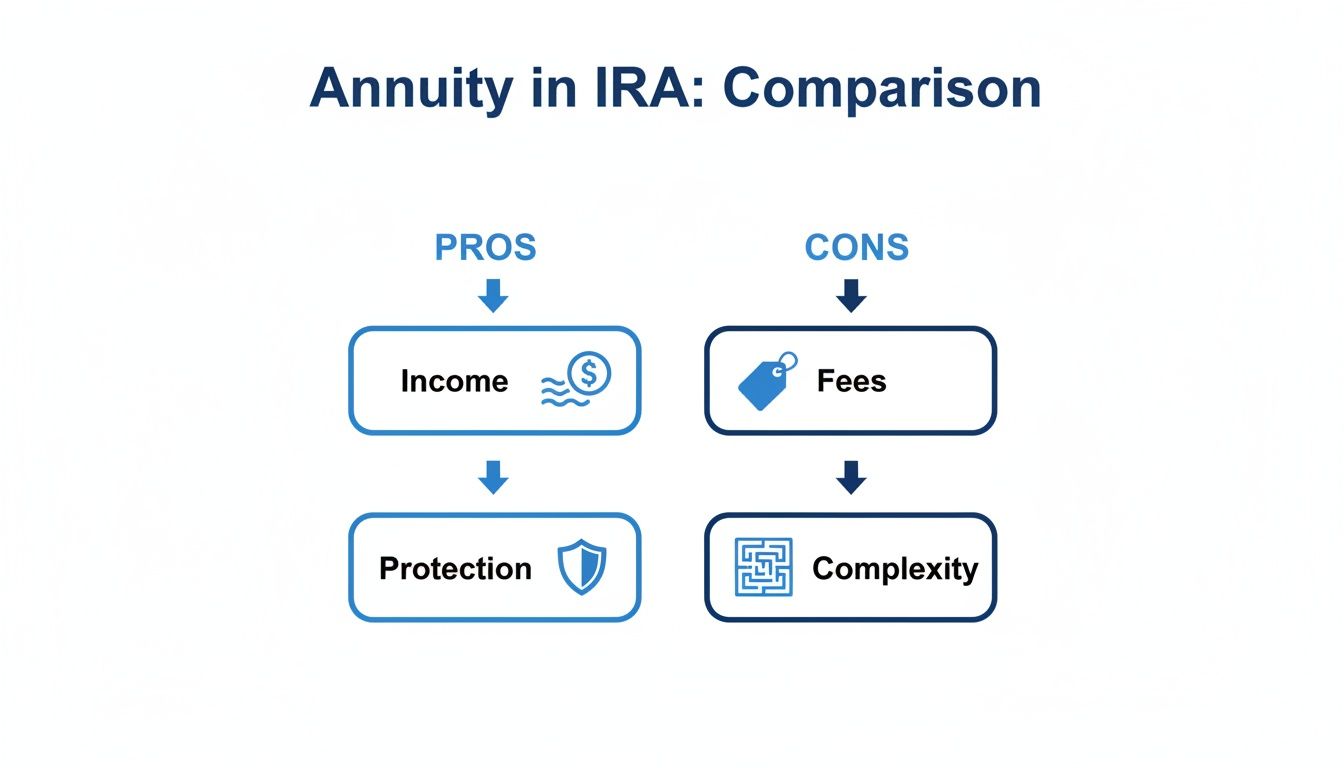
It really boils down to this: you get ironclad income reliability (a huge pro), but you have to accept the annuity's costs and rules (the con).
A Real-World Example in Action
Let's look at Sarah, a 55-year-old who is ready to retire right now. She’s built a healthy IRA, but can't access it for another four and a half years without getting hit with penalties.
Here’s how she can put this strategy to work:
- Calculation: After working with a financial specialist, Sarah figures out she can withdraw $40,000 a year from her IRA under a 72(t) SEPP plan.
- Funding: She uses a piece of her IRA to purchase an immediate annuity.
- Execution: That annuity is specifically structured to pay her exactly $40,000 every year, on the dot.
- Result: Sarah now has a reliable income bridge to cover her living expenses until she turns 59½. Best of all, it's completely penalty-free.
This strategy effectively turns a portion of an IRA into a private pension, providing the stable income needed to make early retirement a reality. It’s a precise financial maneuver that requires expert guidance to execute correctly.
Because the stakes are so high, this is absolutely not a DIY project. Working with a specialist firm like Spivak Financial Group is critical. As the experts behind 72tProfessor.com, they have the deep, specific expertise needed to navigate the complex IRS rules, structure the annuity perfectly, and ensure your early retirement plan is built on a solid, penalty-free foundation.
So, Is an Annuity in an IRA the Right Move for You?
Deciding whether to put an annuity inside your IRA isn't something you can get a simple "yes" or "no" answer to. It’s a deeply personal choice. The right answer is the one that fits squarely with your retirement goals, how you feel about market risk, and what you hope to leave behind for your family.
This isn't just theory, either. We're seeing a real shift in how people are preparing for retirement, especially with all the market ups and downs. The demand for the kind of guarantees an annuity can offer has exploded. Just look at the numbers: in the first half of the year alone, U.S. annuity sales hit roughly $300.7 billion. That’s a massive jump of about $59.6 billion from the previous year.
This tells us one thing loud and clear: retirees are actively moving their money into vehicles that provide a predictable, steady income stream. You can read more about this record-breaking growth in the U.S. annuity market.
Key Questions to Ask Your Financial Advisor
Before you sign on the dotted line, you absolutely need to sit down with a financial professional. Think of this as your final gut check. Going in armed with the right questions will make sure you’re not just buying a product, but a solution that truly fits your life.
Here’s what you should be asking:
- Income Needs: How exactly will this annuity's payout structure give me the monthly income I need to live comfortably in retirement?
- Fees and Charges: I need a full, transparent breakdown of every single fee. What are the mortality and expense charges, administrative fees, and any costs for riders? Show me how these will chip away at my returns over time.
- Liquidity and Access: What happens if I have an emergency? I need to know the surrender charges, how long they apply, and exactly how much I can take out each year without getting hit with a penalty.
- Guarantees vs. Goals: Does this specific annuity's guarantee directly solve my biggest worries, like running out of money or losing my principal in a market crash?
- Legacy Planning: How does this annuity get passed on to my kids or other beneficiaries? What choices will they have? Are there any death benefits that make it more attractive?
Making a Decision You Can Feel Good About
The whole point of this process is to get you to a place of confidence and security about your financial future. An annuity in an IRA can be a phenomenal tool for creating that kind of peace of mind, but it’s not a decision to be taken lightly. It demands careful thought and solid, expert advice.
Your retirement strategy should be built on a foundation of clarity and confidence. The right financial product not only provides income but also aligns perfectly with your life goals, ensuring you can enjoy the years you've worked so hard for.
Trying to make sense of annuity contracts and IRA rules on your own can feel overwhelming. For guidance that’s tailored specifically to you, it often helps to talk to specialists. You can get in touch with a team like Spivak Financial Group at (844) 776-3728. A professional can help you lay out all the pros and cons, making sure your final decision is one you’ll be happy with for years to come.
A Few Final Questions About Annuities in IRAs
Even after getting the basics down, it’s completely normal to have some lingering questions about putting an annuity inside an IRA. Let's tackle some of the most common ones I hear from clients, giving you the straightforward answers you need to move forward confidently.
Is It a Bad Idea to Put an Annuity in an IRA?
It’s not automatically a "bad" idea, but it’s a very specific tool for a specific job. The big mistake people make is thinking they're doing it for tax reasons. You’re not—the IRA is already tax-deferred.
The real reason to do this is for the contractual guarantees that only an annuity can offer: lifetime income, principal protection, or specific death benefits.
If your main goal is to build your own personal pension—a reliable, predictable income stream that you can’t outlive—then it can be a brilliant move. But if you don't really need those ironclad guarantees, or if the fees are going to eat away at the benefits for your particular situation, then it's probably not the right fit.
How Do RMDs Work with an Annuity in an IRA?
This is a great question. You still have to take Required Minimum Distributions (RMDs) from your traditional IRA, which usually kicks in at age 73. The good news is that an annuity can make handling RMDs much simpler.
Think of it this way: if the guaranteed income payments you receive from your annuity are equal to or more than your calculated RMD for the year, you're all set. Those payments automatically satisfy the IRS requirement.
If the annuity payments are a little less than your RMD, you just need to withdraw the small difference from other funds in that same IRA. Many modern annuities are even built to be "RMD-friendly," meaning they can handle the calculations for you.
Can I Put an Annuity Inside My Roth IRA?
Yes, you absolutely can, but the thinking behind it is completely different. Since a Roth IRA already gives you 100% tax-free distributions in retirement, the tax-deferral feature of an annuity is totally redundant.
So, why do it? For one reason only: the insurance guarantees.
This strategy allows you to:
- Create a guaranteed stream of tax-free income for the rest of your life.
- Shield your Roth principal from any stock market losses.
- Set up a specific death benefit for your heirs.
For someone who wants to lock in a secure, tax-free pension for themselves, this can be an incredibly powerful strategy. You just have to be sure the annuity’s costs are worth it for those unique benefits.
What Happens to My IRA Annuity When I Die?
When you pass away, what's left in the annuity goes straight to the beneficiaries you named on the contract. What they can do with it depends on the specific terms of your annuity and the IRS rules for inherited IRAs at that time.
Upon your death, the annuity becomes a critical part of your legacy plan. The structure of the contract determines how smoothly and efficiently that value is transferred to the people you care about most.
Typically, beneficiaries can choose to take a lump sum, stretch distributions over their own lifetime (though this is now limited for most non-spouse beneficiaries), or take the full amount within 10 years. Many annuities also offer enhanced death benefit riders that can actually increase the amount your loved ones receive, making it a valuable estate planning tool.
Navigating the complexities of an annuity in an IRA, especially for specialized strategies like a 72(t) SEPP, requires expert guidance. The team at Spivak Financial Group provides the specialized knowledge needed to build a retirement plan that offers security and peace of mind. To see how these strategies can unlock your financial future, visit https://72tprofessor.com.